
Training plan
Module 1: Understanding DevOps Culture
This module explores the fundamental principles of DevOps culture, emphasizing collaboration and communication between development and operations teams to accelerate software delivery.
Module 2: Introduction to DevSecOps
This module presents the integration of security into the DevOps lifecycle, highlighting the importance of security from the beginning of the software development process.
Module 3: DevSecOps Pipeline-Plan Stage
This module details the strategies and planning tools used to integrate security practices into the planning phase of the DevSecOps pipeline.
Module 4: DevSecOps Pipeline-Code Stage
This module focuses on best practices for secure coding, including the use of static code analysis to identify vulnerabilities early in the development process.
Module 5: DevSecOps Pipeline-Build and Test Stage
This module explains how to automate security testing in the build and test process, ensuring that applications are secure before deployment.
Module 6: DevSecOps Pipeline-Release and Deploy Stage
This module covers secure deployment techniques, including the use of Infrastructure as Code (IaC) and continuous deployment practices to maintain the security of applications in production.
Module 7: DevSecOps Pipeline-Operate and Monitor Stage
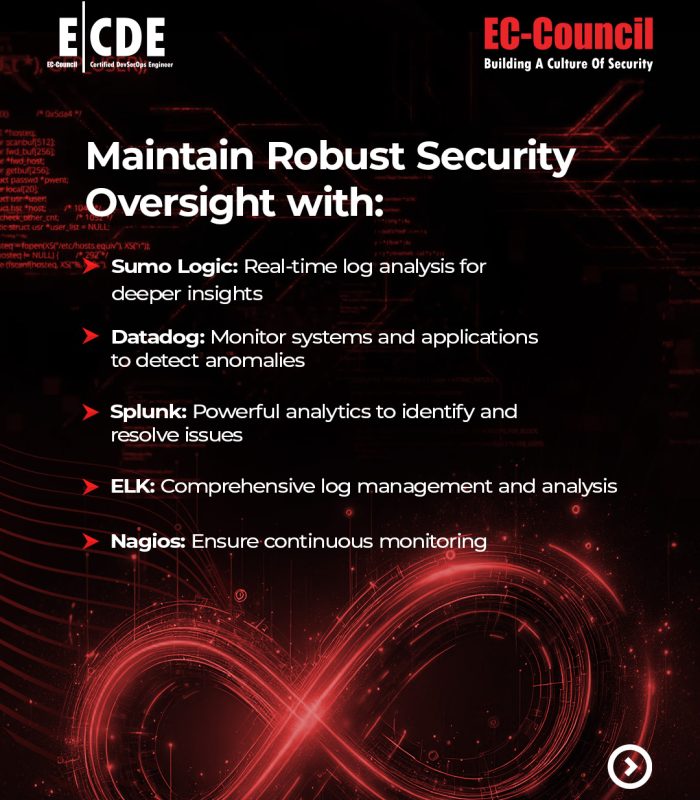
This module addresses tools and techniques for continuous monitoring and incident management to ensure the security and resilience of applications in operation.
Course preview
Recommended prerequisite knowledge
- Basic Understanding of DevOps: Familiarity with DevOps concepts and practices, including continuous integration, continuous delivery, and infrastructure as code.
- Knowledge of Security Fundamentals: Understanding of basic security principles and practices, including threat modeling, vulnerability management, and secure coding practices.
- Experience with Development and Operations Tools: Practical experience with development and operations tools commonly used in DevOps environments, such as version control systems (e.g., Git), CI/CD pipelines, containerization (e.g., Docker), and orchestration tools (e.g., Kubernetes).
- Technical Background: A technical background in computer science, software development, or system administration is highly recommended to grasp the complex topics covered in the training.
Credentials and certification
Exam features
- Code: 312-97
- Title: Certified DevSecOps Engineer
- Duration: 4 hours
- Number of Questions: 100
- Question Format: Multiple Choice
- Online with EC-Council Exam Center
- Cost: $0 (included in your training)
Integration of the ECDE Certification with EC-Council Pathways
Obtaining the ECDE certification enhances and completes your skills within the main EC-Council pathways. Discover how ECDE fits into each track.
SOC Pathway (Security Operations Center)
With the rise of cloud-native and DevOps practices, SOC teams must integrate security automation, continuous monitoring, and proactive defense strategies. ECDE trains professionals to embed security throughout the DevOps lifecycle, manage vulnerabilities, and respond to threats in dynamic environments. This expertise is essential for modern SOC operations focused on rapid detection and effective mitigation.
Related training for this pathway:
Leadership Pathway
Security leaders and decision-makers face the challenge of embedding security culture and governance into fast-paced development and operational environments. ECDE provides a comprehensive understanding of DevSecOps principles, risk management, and compliance frameworks that support secure digital transformation initiatives.
Related training for this pathway:
Cybercrime Investigation Pathway
While ECDE is primarily focused on proactive defense and secure development, its knowledge of secure coding, automation, and incident response supports forensic teams by reducing vulnerabilities and improving incident traceability in modern application environments.
Related training for this pathway:
AI Pathway (ADG) – Adoption, Test & Governance
As organizations operationalize AI through cloud-native and DevOps workflows, security must be embedded across the entire lifecycle—from data and model pipelines to deployment, monitoring, and continuous improvement. The ECDE certification strengthens the “secure-by-design” foundation required to deliver AI initiatives that are production-ready, resilient, and compliant. It complements the ADG pathway by reinforcing secure CI/CD practices, automation, vulnerability management, and governance controls that reduce risk when AI systems move from pilot to enterprise scale.
Related training for this pathway:
Other Complementary Certifications
Certified Cloud Security Engineer (CCSE)
The CCSE certification complements ECDE by focusing on cloud security architecture, risk management, and compliance in hybrid and multi-cloud environments.
EC-Council Disaster Recovery Professional (EDRP)
The EDRP certification prepares professionals to manage disaster recovery and business continuity planning, ensuring organizational resilience after major incidents.
Ready to strengthen your cybersecurity expertise?
Eccentrix Corner Articles: Resources EC-Council Disaster Recovery Professional (EDRP v3) EC-6169
Explore our technical articles on EC-Council Disaster Recovery Professional (EDRPv3) EC-6169 published on Eccentrix Corner. These resources delve into key disaster recovery concepts, share business continuity best practices, and provide practical guides to maximize your learning and achieve EDRP certification. Our experts share real-world insights to help you master planning, risk management, and organizational resilience in the face of major incidents.


ECDE DevSecOps Engineer Training
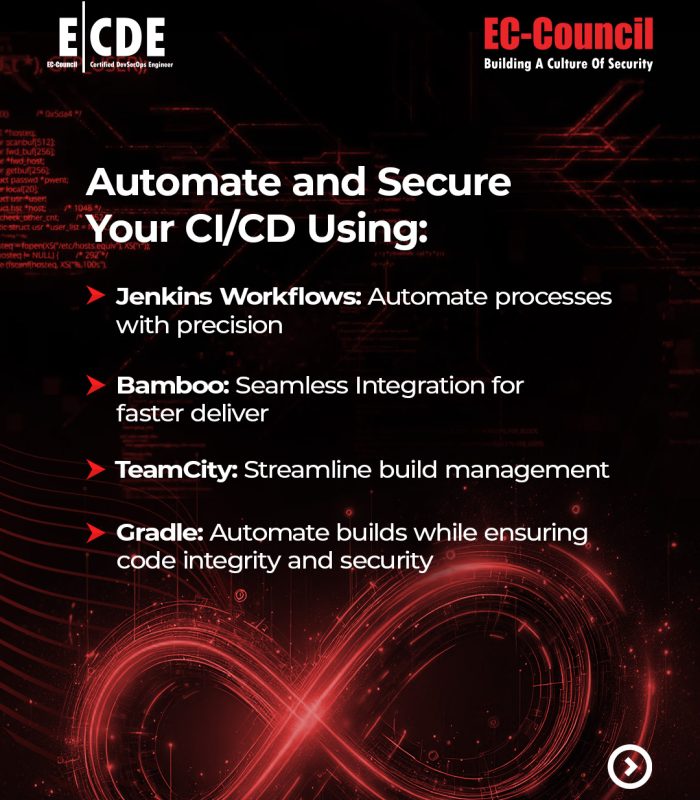
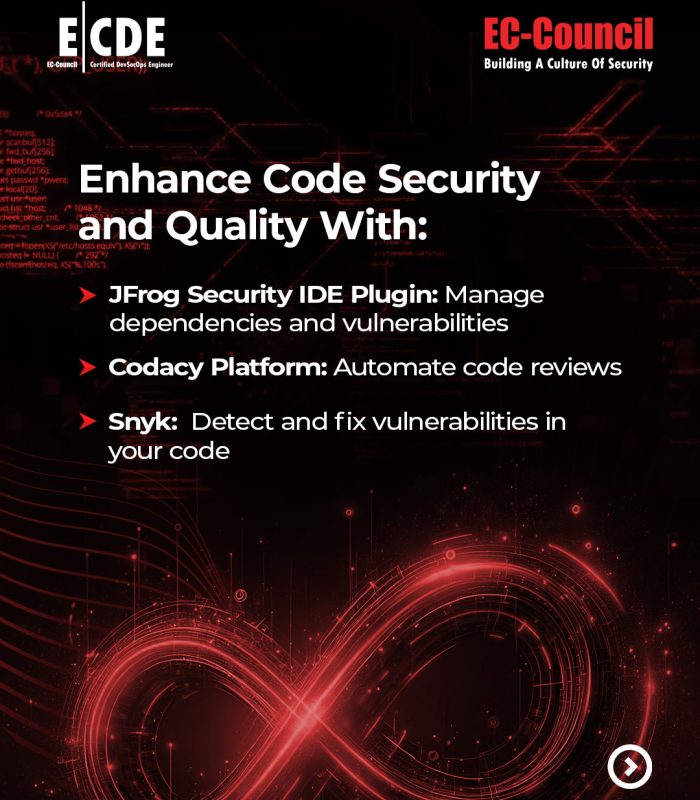
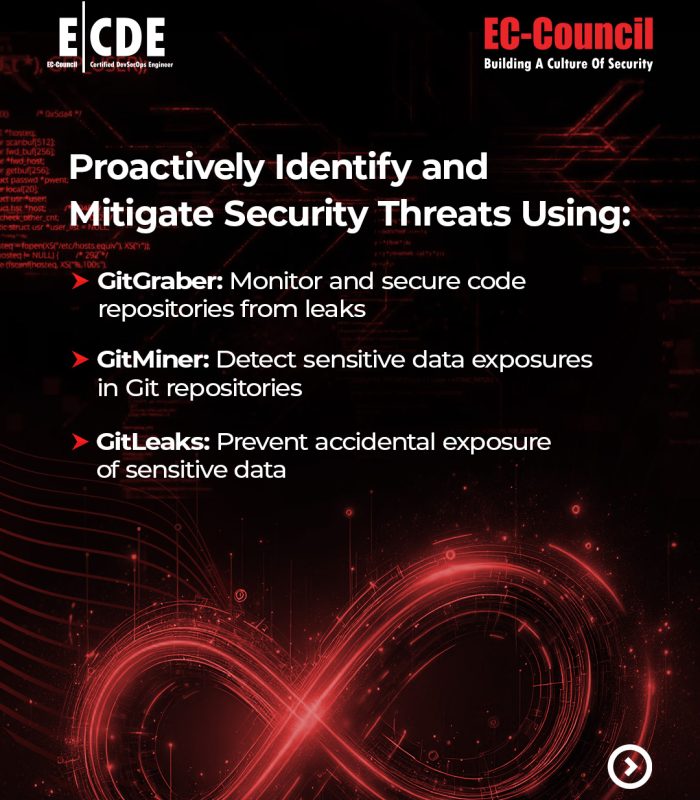
The ECDE DevSecOps Engineer training equips IT professionals with the essential skills to integrate security practices into DevOps workflows. This course emphasizes secure software development, automation, and continuous integration/continuous delivery (CI/CD) pipelines to enhance system security and operational efficiency.
Participants gain hands-on experience in applying DevSecOps methodologies, preparing for the ECDE certification and enabling them to bridge the gap between development, operations, and security.
Why Choose the ECDE Training?
With the rapid adoption of DevOps, integrating robust security measures into software development has become critical. The ECDE training prepares professionals to identify vulnerabilities, implement security controls, and ensure compliance without disrupting agile workflows.
Achieving the ECDE certification demonstrates your ability to build secure, scalable, and resilient systems, making you an asset in modern software development and IT operations.
Key Skills Developed in the Training
Secure DevOps practices
Master the principles of integrating security into DevOps processes, ensuring robust development pipelines.Threat identification and mitigation
Learn to analyze security vulnerabilities and implement preventive measures in real-time environments.Automation and CI/CD integration
Gain expertise in automating security checks and integrating them seamlessly into CI/CD workflows.Compliance and governance
Understand regulatory requirements and implement practices to ensure adherence in DevSecOps processes.Incident response and recovery
Develop strategies for responding to security incidents and restoring system integrity quickly.Prepare for the ECDE certification exam
Acquire the knowledge and skills needed to excel in the ECDE certification and advance your career in DevSecOps.
Interactive Training Delivered by Experts
This course is delivered by experienced instructors specializing in DevSecOps methodologies. Participants engage in practical labs, real-world scenarios, and case studies, ensuring a comprehensive understanding of security in DevOps.
Who Should Attend?
This training is ideal for:
- DevOps professionals aiming to specialize in security practices
- IT security engineers seeking to integrate DevOps workflows
- Software developers and architects focusing on secure application design
- Individuals preparing for the EC-Council Certified DevSecOps Engineer (ECDE) certification
Transform DevOps with Security Expertise
The EC-Council Certified DevSecOps Engineer (ECDE) (EC6172) training provides the skills to secure modern software development and IT operations. Enroll today to achieve a globally recognized certification and advance your career in DevSecOps.
Exam Success Strategies for ECDE v2
Mastering the EC-Council Certified DevSecOps Engineer (ECDEv2) certification requires more than technical knowledge—strategic integration of security into DevOps workflows, automation expertise, and comprehensive understanding of CI/CD security are equally crucial for success. By understanding secure coding practices, security automation tools, and continuous monitoring methodologies, you’ll develop the confidence and expertise needed to excel in the ECDEv2 certification exam.
ECDE v2 Exam Statistics & Success Rates
- Average Pass Rate: 68-73% on first attempt
- Most Common Score Range: 72-80% for passing candidates
- Average Study Time: 4-6 weeks for experienced DevOps engineers or security professionals with CI/CD pipeline experience
- Retake Rate: 22-27% of candidates require a second attempt
- Top Failure Areas: Security automation and tool integration (30%), secure CI/CD pipeline implementation (26%), container and cloud security (24%)
Study Method Comparison
| Study Approach | Duration | Pass rate | Best For |
|---|---|---|---|
|
Hands-on Practice Only |
5-7 weeks |
45-55% |
Experienced DevOps engineers |
|
Documentation + Practice |
7-9 weeks |
68-73% |
Methodical learners |
|
Training + Labs + Practice |
4-6 weeks |
80-87% |
Comprehensive preparation |
|
Practice Tests Only |
3-4 weeks |
35-45% |
Not recommended |
Strategic Study Approach
- Create a 4-6 week study schedule – DevSecOps requires deep understanding of security integration across the entire software development lifecycle
- Follow the 70-20-10 rule – 70% hands-on practice with DevSecOps tools and pipeline automation, 20% reading documentation and security frameworks, 10% practice exams
- Focus on practical integration – ECDEv2 emphasizes real-world application of security automation rather than theoretical security concepts
- Study in 90-minute blocks with 15-minute breaks to maximize retention and avoid burnout
- Practice with DevSecOps tools repeatedly – understand Jenkins, GitLab CI/CD, Docker, Kubernetes, Terraform, security scanning tools, and monitoring platforms
- Master the entire DevSecOps pipeline – comprehend security integration at every stage: Plan, Code, Build, Test, Release, Deploy, Operate, Monitor
- Understand both on-premises and cloud environments – ECDEv2 covers security implementation in AWS, Azure, and traditional infrastructure
Common Exam Pitfalls to Avoid
- Don’t confuse DevOps with DevSecOps – Know how to integrate security practices into existing DevOps workflows without disrupting agility
- Security automation is not optional – Understand how to automate security testing, vulnerability scanning, and compliance checks in CI/CD pipelines
- Container security has unique requirements – Know Docker security best practices, image scanning, registry security, and runtime protection
- Infrastructure as Code (IaC) requires security validation – Understand how to scan Terraform, CloudFormation, and Ansible configurations for vulnerabilities
- Static and dynamic analysis serve different purposes – Know when to use SAST, DAST, IAST, and SCA tools in the pipeline
- Secrets management is critical – Understand how to securely manage credentials, API keys, and certificates in automated environments
- Cloud security is platform-specific – Know AWS, Azure, and multi-cloud security configurations and best practices
- Monitoring must include security metrics – Understand how to implement security monitoring, logging, and alerting in production environments
- Compliance automation is essential – Know how to implement automated compliance checks and policy enforcement
- Shift-left security is a mindset change – Understand how to embed security early in the development process and foster security culture
Topic Weight Distribution
| Exam Domain | Weight | Focus Areas | Priority |
|---|---|---|---|
|
DevSecOps Pipeline – Code Stage |
20-25% |
Secure coding, SAST tools, code review, Git security, IDE security plugins |
Critical |
|
DevSecOps Pipeline – Build & Test |
18-22% |
Build automation, DAST tools, dependency scanning, SCA, automated testing |
Critical |
|
DevSecOps Pipeline – Release & Deploy |
16-20% |
IaC security, container security, deployment automation, release management |
Critical |
|
Security Automation & Tool Integration |
14-18% |
CI/CD security tools, Jenkins, GitLab, security orchestration, API security |
High |
|
Container & Orchestration Security |
12-15% |
Docker security, Kubernetes security, image scanning, runtime protection |
High |
|
DevSecOps Pipeline – Operate & Monitor |
10-13% |
Security monitoring, logging, SIEM integration, incident response automation |
High |
|
DevOps Culture & DevSecOps Introduction |
6-8% |
DevOps principles, security culture, collaboration, DevSecOps fundamentals |
Medium |
|
DevSecOps Pipeline – Plan Stage |
4-6% |
Threat modeling, security requirements, risk assessment, planning tools |
Medium |
Exam Day Time Management
- Allocate approximately 1.5 minutes per question on average – this gives you buffer time for complex pipeline security scenarios
- Read scenario questions completely before attempting to answer – DevSecOps questions often contain critical details about pipeline stages, tool configurations, or security requirements
- Flag uncertain questions and return to them – don’t get stuck on difficult tool integration scenarios and waste valuable time
- Reserve 10-15 minutes at the end to review flagged questions and double-check your answers
- Manage tool-specific questions strategically – prioritize questions related to your strongest DevSecOps domains first
Managing Exam Stress & Performance
- Get 7-8 hours of quality sleep the night before – avoid last-minute cramming that reduces problem-solving capacity
- Log in to the exam site 5-10 minutes early – settle in and complete check-in procedures calmly
- Use deep breathing techniques if you feel overwhelmed during the exam – clear technical thinking is essential for pipeline security questions
- Trust your hands-on experience – your first instinct is usually correct for scenario-based DevSecOps questions
- Remember that the passing score is 70% – you don’t need perfection, just solid competence in DevSecOps practices
Technical Preparation Tips
- Master CI/CD security integration – understand how to embed security tools at every pipeline stage without breaking automation
- Practice with security scanning tools – know how to configure and interpret results from SAST (SonarQube, Checkmarx), DAST (OWASP ZAP, Burp Suite), and SCA (Snyk, WhiteSource) tools
- Understand container security deeply – know Docker security best practices, image scanning with Trivy/Clair, registry security, and Kubernetes security policies
- Master Infrastructure as Code security – know how to scan Terraform, CloudFormation, and Ansible for misconfigurations and vulnerabilities
- Practice secrets management – understand HashiCorp Vault, AWS Secrets Manager, Azure Key Vault, and secure credential handling in pipelines
- Understand cloud security configurations – know AWS security services (IAM, GuardDuty, Security Hub), Azure security (Defender, Security Center), and multi-cloud security
- Master security monitoring and logging – know how to implement centralized logging, SIEM integration, and security alerting in production
- Practice with orchestration security – understand Kubernetes RBAC, network policies, pod security policies, and service mesh security
Final Week Preparation
- Take 2-3 full practice exams to identify knowledge gaps and build confidence
- Review the official ECDEv2 exam domains from EC-Council one final time
- Focus on your weakest areas – security automation, CI/CD pipeline security, and container security are the most common failure areas
- Avoid learning new tools – focus on reinforcing what you already know
- Prepare your exam day logistics – required identification, computer setup for online proctoring
Mental Preparation Strategies
- Visualize success scenarios – imagine yourself confidently analyzing pipeline security scenarios and implementing automation solutions
- Recall your DevOps experience – you’ve likely worked with CI/CD pipelines, containers, and automation tools before
- Stay positive when facing difficult questions – all candidates encounter challenging security integration scenarios
- Remember that DevSecOps is a practical skill – your hands-on pipeline experience is your greatest asset
- Approach the exam as a validation of your security automation expertise, not a test of memorized tool commands
How to Schedule Your ECDE v2 Exam
- Testing is done online with EC-Council Exam Center, the authorized testing partner for ECDEv2
- Scheduling Process: Create an account, search for “ECDE” or “312-97”, select your date
- Exam Cost: Included in your Eccentrix training – exam voucher provided for this certification
- Scheduling Timeline: Book at least 1-2 weeks in advance for better time slot availability
- Rescheduling Policy: Free rescheduling up to 24 hours before your exam appointment
- Required ID: Government-issued photo ID (passport, driver’s license) matching your registration name exactly
Success Mindset: Approach ECDEv2 as a validation of your ability to integrate security seamlessly into DevOps workflows, automate security testing, and build secure, scalable systems, not as a test of memorized tool configurations. Your practical pipeline experience and security automation skills are your greatest assets.
Frequently asked questions
What are the prerequisites for the ECDE training?
A basic understanding of DevOps workflows and IT security concepts is recommended.
What topics are covered in the course?
The course covers secure DevOps practices, CI/CD security integration, vulnerability management, and governance.
Does the training include hands-on exercises?
Yes, the course features practical labs and scenarios to ensure participants can apply their knowledge effectively.
What tools are used during the training?
Participants work with CI/CD tools, security scanners, and DevSecOps frameworks.
How does the ECDE certification benefit my career?
The certification validates your ability to integrate security into DevOps workflows, enhancing your value in IT and software development roles.
Is this training aligned with the ECDE certification objectives?
Yes, the course content is fully aligned with the requirements of the ECDE certification exam.