
Training plan
Module 1 : Introduction to Artificial Intelligence
- Understand AI evolution, milestones, and future directions
- Explore the collaboration between humans and AI
- Recognize data, algorithms, and models as the foundation of AI systems
Module 2 : Everyday AI Tools and Use Cases
- Identify AI tools in daily life and the workplace
- Explore AI applications in manufacturing, transportation, education, and security
- Understand how AI improves productivity and decision-making
Module 3 : Building Blocks of AI
- Understand AI models, ML, neural networks, NLP, and Generative AI (LLMs)
- Select appropriate AI tools for project needs
Module 4 : Prompt Crafting for AI-Driven Interactions
- Learn prompt engineering principles
- Structure effective prompts to generate accurate and useful AI outputs
Module 5 : AI Ethics and Responsible AI
- Identify societal, ethical, and security concerns
- Apply governance, responsible practices, and global standards

Recommended prerequisite knowledge
- No prior knowledge of artificial intelligence is required (beginner level accepted).
- Be comfortable using a computer and web tools (browsing, accounts, forms, searching).
- Understand basic technical English (common terms: AI, data, model, prompt, privacy, bias), depending on the material/exam.
- Have professional or academic experience handling information (documents, emails, reports) to apply use cases.
- General knowledge of security and confidentiality (best practices: sensitive data, access, sharing) — recommended for the “Responsible AI” section.
- Curiosity and critical thinking: willingness to evaluate the responses of an AI tool (quality, limitations, biases) rather than automatically accepting them.
Credentials and certification
Exam features
- Code: 112-59
- Title: Artificial Intelligence Essentials (AIE)
- Duration: 2 hours
- Number of Questions: 75
- Question Format: Multiple Choice
- Online with EC-Council Exam Center
- Cost: $0 (included in your training)
EC-Council Career Advancement Pathway
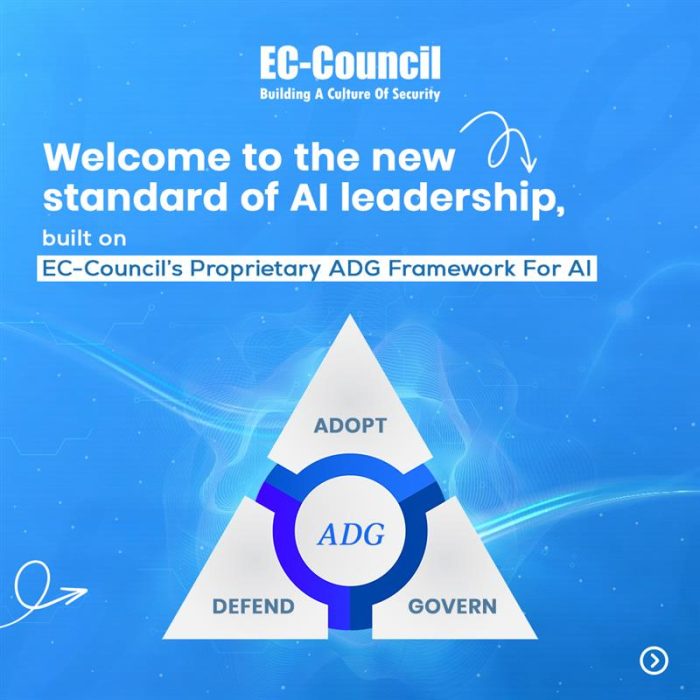
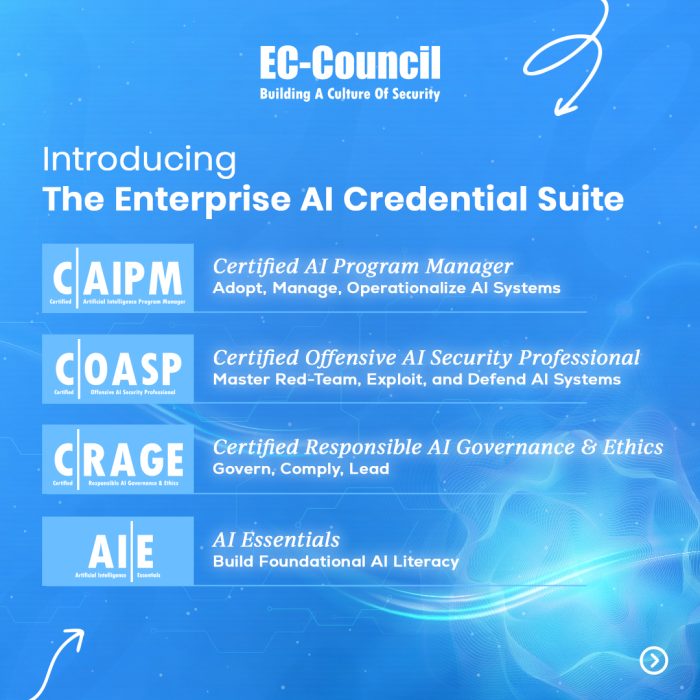
Eccentrix offers a structured EC-Council certification path to specialize in AI adoption, testing, and governance. This path is designed to address market realities (accelerated adoption, real-world incidents, compliance requirements) and to align your skills with the roles that drive AI in production, securely and audit-ready.
Recommended EC-Council Digital Forensics & Cybercrime Investigations Pathway
- 🤖 Level 1 – Foundations (AI Literacy) – You are here
Artificial Intelligence Essentials (AIE) – Understand the basics of AI, its use cases, its limitations, and best practices for using it responsibly on a daily basis. - 📈 Level 2 – ADOPT (Piloting & Scaling) – Next step
Certified AI Program Manager (CAIPM) – Define and manage end-to-end AI initiatives: maturity, use case selection, roadmap, change management, operational governance, and value measurement. - 🛡️ Level 3 – DEFEND (Offensive AI Security) – Next step
Certified Offensive AI Security Professional (COASP) – Evaluate the security of AI systems from an attacker’s perspective: red teaming, LLM, prompt injection, attacks on applications/pipelines/agents, supply chain risks, then hardening and incident response. - ⚖️ Level 4 – GOVERN (AI Governance & Ethics) – Next Step
Certified Responsible AI Governance & Ethics (CRAGE) – Governance, risk, compliance (EU AI Act / NIST AI RMF / ISO), privacy, assurance, audit. - 👔 Level 5 – Cybersecurity Leadership (C-suite) – Expert Achievement
Certified Chief Information Security Officer (CCISO) – Executive leadership, governance, strategy, finance, security program, board alignment, and leadership in addressing AI threats.
Duration and Salary Progression by Level
| Level | Certification | Duration | Average Salary (CAD) |
|---|---|---|---|
|
1 |
Artificial Intelligence Essentials |
2 days |
$70,000 – $120,000 (depending on the position: analyst, specialist, manager, etc.) |
|
2 |
Certified AI Program Manager |
3 days |
$120,000 – $170,000 (AI program management / transformation / TPM) |
|
3 |
Certified Offensive AI Security Professional |
5 days |
$130,000 – $190,000 (AI security / red team / advanced AppSec) |
|
4 |
Certified Responsible AI Governance & Ethics |
3 days |
$110,000 – $160,000 (AI governance / risk & compliance / audit) |
|
5 |
Certified Chief Information Security Officer |
5 days |
$170,000 – $260,000 (CISO / security director / cybersecurity director) |
- Total program duration: 6–18 months
- Potential salary increase: ~+125% from Level 1 to Level 5
Skills Development by Level
| Skill Area | AIE | CAIPM | COASP | CRAGE | CCISO |
|---|---|---|---|---|---|
|
AI culture (concepts, uses, limits) |
Mastered |
Advanced |
Advanced |
Advanced |
Advanced |
|
Adoption & transformation (maturity, use cases, roadmap) |
Concepts |
Mastered |
Concepts |
Advanced |
Advanced |
|
AI security (LLM applications, agents, pipelines, hardening) |
Awareness |
Concepts |
Mastered |
Advanced |
Advanced |
|
Governance / ethics / compliance (EU AI Act, NIST, ISO) |
Concepts |
Advanced |
Advanced |
Concepts |
Mastered |
|
Executive leadership (strategy, budget, governance, board of directors) |
Awareness |
Concepts |
Concepts |
Concepts |
Mastered |
Level 1 – Foundations with AI Literacy (Your current stage)
Why this is your logical next step:
AIE establishes a solid foundation for using AI with confidence and discernment. You learn what AI (and GenAI/LLM) is, how it produces results, where it can fail (limitations, biases, hallucinations), and how to evaluate outputs before incorporating them into your decisions. The program also develops practical skills in AI tools and prompt crafting, while framing responsible use (ethics, confidentiality, best practices). This is the step that transforms “gut feeling” use into structured, critical, and safe use.
Typical Roles:
- Non-IT professionals (operations, marketing, finance, HR, etc.) looking to use AI effectively
- Analysts/project and operations managers (productivity improvement, summaries, research, reporting)
- IT professionals/engineers (AI basics + prompting + responsible use before advanced training)
- Trainers/teachers (integrating AI literacy)
- Entrepreneurs/decision-makers (informed adoption, risk reduction)
Average salary in Canada: 70 000 $ – 120 000 $ CAD
Estimated training duration: 2–4 weeks
Level 2 – ADOPT with CAIPM (Managing AI in Production) (Recommended Next Step)
After validating the foundations with AIE (AI literacy, prompting, boundaries, and responsible use), CAIPM structures the transition from pilot to production: governance and responsibilities (ownership), maturity assessment, use case prioritization, change management, tool integration, and value measurement. This is the step that transforms AI into concrete and measurable results.
Level 3 – DEFEND with COASP (Next recommended step)
Building on the foundations of AIE and CAIPM (foundations + enterprise deployment), COASP focuses on the offensive security of AI systems: LLM red teaming, prompt injection, attacks on applications, agents, and data pipelines, followed by hardening and incident response. This stage prepares you for specialized roles in “proof-of-test” securing of AI solutions in production.
Level 4 – GOVERN with CRAGE (Recommended next step)
After understanding how to deploy (CAIPM) and test (COASP) AI systems, CRAGE guides you into the realm of responsible governance: risk management, ethics, data protection, controls, compliance, and audit readiness (EU AI Act, NIST AI RMF, ISO). This is the step that makes your AI initiatives auditable, defensible, and aligned with regulatory requirements.
Level 5 – Cybersecurity Leadership with CCISO (Consolidation Stage – Executive Level)
Once Adoption, Testing, and Governance (ADG) is in place, CCISO v4 strengthens the ability to lead a security program at the executive level: strategy, governance, finance, performance monitoring, board alignment, and risk management, including AI-related risks. This step positions you to lead security across the organization with a sustainable, results-oriented vision.
Other Available EC-Council Pathways
After completing the AI – Adoption, Testing & Governance (ADG) track, you can also explore other specialized tracks or complementary certifications:
Ethical Hacking Technical Pathway
- Certified Ethical Hacker (CEH)
- Certified Network Defender (CND)
- Certified Penetration Testing Professional (CPENT)
Security Operations Center (SOC) Pathway
- Certified Cybersecurity Technician (CCT)
- Certified Security Analyst (CSA)
- EC-Council Certified Incident Handler (ECIH)
- Certified Threat Intelligence Analyst (CTIA)
Cybercrime Investigation Pathway
Leadership Pathway
Complementary Certifications
Benefits of the Complete Pathway
Structured Progression (ADG)
Each certification builds upon the previous one to develop comprehensive expertise: adopting AI, testing its robustness, governing its use, and then bringing the strategy to the executive level.
Market alignment (AI in production)
Designed to meet the real needs of organizations: accelerated deployment, real-world incidents (prompt injection, leaks, fraud) and compliance requirements.
Audit-ready governance
Develops the skills needed to implement assurance policies, controls and mechanisms aligned with reference frameworks (EU AI Act, NIST AI RMF, ISO).
Risk reduction through evidence
Validation-oriented approach: offensive testing, hardening and incident response preparation to secure AI systems before an incident occurs.
Career acceleration & credibility
Positions you for high-value roles (AI program, AI security, AI governance, cybersecurity leadership) with recognized and job-role-oriented certifications.
Ready to Advance?
Eccentrix Corner Articles: Artificial Intelligence Essentials (AIE) EC-6175 Resources
Explore our technical articles on Artificial Intelligence Essentials (AIE) published on Eccentrix Corner. These resources help you build strong AI literacy and use AI effectively, critically, and responsibly in your daily work. You’ll find practical content on the fundamentals (AI vs. GenAI/LLM), real-world workplace use cases, prompt crafting, evaluating the quality of results (limitations, biases, hallucinations), and best practices related to ethics, privacy, and security. Our experts share simple and applicable methods for integrating AI into your workflows (research, synthesis, communication, light automation) while reducing risk and increasing confidence in your decisions—excellent preparation for AIE certification and more advanced AI pathways.



Artificial Intelligence Essentials training (AIE) EC-6175
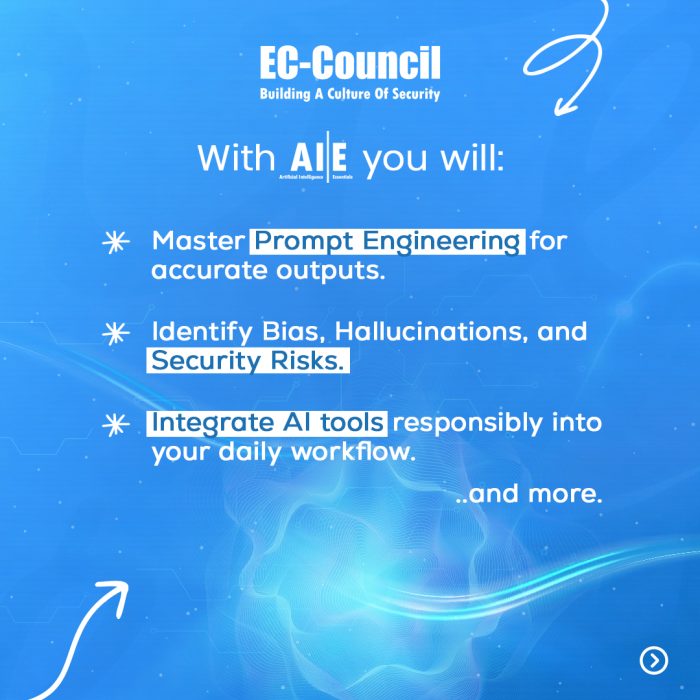
The Artificial Intelligence Essentials (AIE) course (EC-6175) prepares professionals and students to develop verified AI literacy to understand artificial intelligence, use AI tools effectively, and make informed decisions in real-world contexts. This course addresses a very real challenge: AI is already ubiquitous in the workplace, but its adoption has outpaced basic understanding—leading to reckless use, overconfidence in results, and risks related to bias, hallucinations, and privacy. AIE bridges this gap by providing a clear and practical foundation for using AI with sound judgment, methodology, and accountability.
Participants learn to distinguish between AI, GenAI, and LLMs, understand how AI systems generate results and where they can fail, and then apply prompt crafting techniques to obtain more useful and reliable answers. The training also emphasizes the critical evaluation of outputs (quality, accuracy, ethical alignment), the responsible integration of AI into workflows (research, synthesis, communication, light automation), and the adoption of best practices in ethics, data protection, and security. The AIE certification validates skills that are now essential: AI fundamentals, practical use of tools, prompting, detection of limitations/risks, and Responsible AI practices—an ideal foundation before pursuing more advanced AI training.
Why Choose the AIE Training?
AI is already everywhere—in productivity tools, search, content creation, analytics, and automation—but most users are leveraging it without a solid foundation: confusion surrounding concepts (AI vs. GenAI vs. LLM), over-reliance on results, a lack of methodology for assessing quality, and blind spots regarding ethics, privacy, and risks. AIE provides you with a clear and practical foundation to move from a “gut feeling” approach to a structured, critical, and responsible use of AI in your daily work.
Earning the Artificial Intelligence Essentials (AIE) certification demonstrates your ability to understand the fundamentals of AI, to interact effectively with modern tools (including prompt crafting), and to apply Responsible AI practices (bias, confidentiality, security, ethical use) in real-world contexts — whatever your profession.
Key Skills Developed in the Training
Fundamentals of AI (AI, GenAI, LLM) and understanding its limitations
Understand how AI systems generate results, what they actually “know”, and where they can fail (limitations, errors, biases, hallucinations).Concrete use cases and selection of the right tools
Learn to recognize relevant uses of AI at work and to choose appropriate tools (text, image, audio, automation) according to the need and level of risk.Prompt crafting (prompt engineering) for more useful results
Master the principles of formulating and structuring prompts to obtain clearer, more precise, and more actionable answers.Critical evaluation of AI results (quality, accuracy, alignment)
Develop validation reflexes: check consistency, detect error signals, compare sources, and avoid automatic acceptance of outputs.Responsible AI: Ethics, Bias, Privacy, and Best Practices
Apply responsible practices: reducing bias, protecting sensitive data, respecting internal rules, and making informed decisions based on AI (without “blind trust”).Integrating AI into workflows (productivity and light automation)
Learn how to integrate AI into daily tasks (research, synthesis, communication, preparation of deliverables, simple automation) while maintaining control and traceability.
Practical training with tool-oriented labs and real-world scenarios
The AIE training is based on a practical approach including labs (tools, prompting, automation, ethics/confidentiality, deepfake detection) to help you develop skills directly transferable to your work environment.
Who Should Attend?
This training is ideal for:
- Non-IT professionals (operations, HR, finance, marketing, sales) who already use AI and want to do it correctly
- Analysts, project managers, and operations managers who want to increase productivity without sacrificing quality or compliance
- IT professionals and engineers who want a solid AI foundation before moving on to more advanced training
- Decision-makers and entrepreneurs who want to adopt AI methodically and reduce risks
- Trainers/teachers who want to integrate structured AI literacy
Boost your AI literacy with AIE
The Artificial Intelligence Essentials (AIE) course (EC-6175) provides you with a comprehensive foundation for understanding AI, making better use of tools, structuring your prompts, and applying responsible practices (ethics, privacy, security). Enroll to earn a recognized certification and accelerate your progression toward more advanced AI pathways—from enterprise adoption (CAIPM) to security (COASP) and governance (CRAGE).
Success Strategies for the AIE Exam
Passing the Artificial Intelligence Essentials (AIE) certification requires more than just an “intuitive” understanding of the tools: it demands structured preparation focused on the fundamentals, prompt writing, critical evaluation of results (quality, accuracy, limitations, bias/hallucinations), and Responsible AI practices (ethics, confidentiality, security). By mastering the 5 AIE modules (concepts → tools & use cases → AI building blocks → prompt crafting → Responsible AI) and practicing on real-world scenarios (research, synthesis, communication, light automation), you develop the necessary skills to answer exam questions effectively and, above all, to apply AI responsibly in your daily work.
AIE Statistics and Success Rates
- Average success rate: 70–80% on the first attempt
- Most common score range: 72-82% for successful candidates
- Average study time: 4-6 weeks (experienced IT/cybersecurity profile); 6-8 weeks (more “business” profile or beginner)
- Retake rate: 15-25% of candidates require a second attempt
- Main areas of failure: responsible AI (ethics, bias, confidentiality/security) (28%), prompt crafting + evaluation/validation of results (limitations, hallucinations, quality) (22%), choice of tools & use cases / integration into workflows (18%), AI fundamentals (AI vs GenAI/LLM, concepts, basic building blocks) (16%), good usage practices in real-world contexts (sensitive data, verification, decision-making caution) (16%).
Study Method Comparison
| Study Approach | Duration | Pass rate | Best for |
|---|---|---|---|
|
Hands-on Practice Only |
6-8 weeks |
45–55% |
Professionals already exposed to AI on a daily basis (tools, prompting, validation) |
|
Documentation + Practice |
8-10 weeks |
65–75% |
Methodical learners who want to consolidate concepts + responsible AI |
|
Training + Labs + Practice |
4-6 weeks |
80-90% |
Complete preparation (certification + application in a real-world context) |
|
Practice Tests Only |
3-4 weeks |
30-40% |
Not recommended (risk of gaps in responsible AI and fundamentals) |
Strategic Study Approach
- Create a modular study plan – AI fundamentals → tools & use cases → AI building blocks → prompt crafting → Responsible AI (ethics/privacy/security).
- Study in “decision” mode (not definition mode) – for each concept, practice answering: what to do, what to check, what the risk is, what safeguards to implement, and what the expected outcome is.
- Apply a 60-30-10 rule – 60% exercises/scenarios (prompts, validation, use cases), 30% structured review, 10% exam-style questions.
- Produce mini-deliverables (even simple ones) to solidify the material: a prompt template (objective → context → constraints → format → quality criteria), an “AI response validation” checklist (consistency, sources, figures, bias, sensitive data), and Responsible AI usage rules (privacy, sharing, storage, internal compliance).
- Practice classifying each scenario: appropriate tool, risk level, sensitive or non-sensitive data, required validation, and expected output format.
- Work on key trade-offs: when to use AI vs. when to avoid it, when to request sources, when to rephrase the prompt, and when to escalate to a human.
- Simulate the communication: practice summarizing an AI response in 30 seconds, including “what I checked / what I didn’t check.”
- Recommended pace: 60–90 minute blocks with short breaks. Alternate between “reading” and “application” to maximize retention.
Common Exam Pitfalls to Avoid
- Confusing AI / GenAI / LLM: the exam tests your ability to correctly categorize the type of system and its limitations.
- Thinking “tool” before “objective”: choosing a tool without a clear objective, expected format, and quality criteria leads to unusable results.
- Underestimating responsible AI: lack of privacy awareness, bias, validation, and ethical use = major risk.
- Neglecting validation: accepting AI output without verifying consistency, figures, sources, or hallucinations.
- Forgetting confidentiality: sharing sensitive data in an AI tool without proper framework or minimization.
- Poorly framing prompts: vague prompts → vague answers; lack of context → errors; no format → unusable deliverables.
- Ignoring limitations: AI can “write well” while being wrong—the exam rewards the most cautious and verifiable answer.
Topic Weight Distribution
| Exam Domain | Weight | Focus Areas | Priority |
|---|---|---|---|
|
AI fundamentals (AI/GenAI/LLM, concepts, limits) |
10-14% |
Key concepts, modes of failure, limitations, vocabulary |
High |
|
AI tools & use cases (text/image/audio/automation) |
12-16% |
Selection of tools, relevant uses, workflow integration |
Critical |
|
Building blocks of AI (data, models, NLP, networks, etc.) |
14-18% |
Practical understanding of the components and their impact on results |
Critical |
|
Prompt crafting (structure, iterations, constraints, formats) |
12-16% |
Quality of prompts, accuracy, formats, success criteria |
Critical |
|
Responsible AI: ethics, bias, privacy, security |
12-18% |
Best practices, risks, safeguards, basic compliance |
Critical |
|
Evaluation & validation of results (quality/reliability) |
10-14% |
Detection of hallucinations, inconsistencies, verification |
High |
|
Real-world use (sensitive data, decisions, lean governance) |
10-14% |
When to use/avoid, validation, traceability, caution |
Critical |
|
Culture & personal adoption (good habits) |
6-10% |
Reflexes, continuous improvement, responsible use |
Medium |
Exam Day Time Management
- Perform a quick initial review: answer the obvious questions first, then mark those requiring further analysis.
- Immediately identify the context: fundamentals / tools & use cases / prompting / responsible AI / validation.
- Look for keywords: prompt, bias, privacy, limitation, hallucination, tool selection, use case, sensitive data.
- Eliminate “good but incomplete answers”: prioritize the most responsible and verifiable option (validation + risk minimization + proper use).
- Reserve 10 to 15 minutes at the end to revisit the marked questions and verify consistency.
Managing Exam Stress & Performance
- Sleep 7 to 8 hours the night before: avoid last-minute cramming, which reduces clarity of judgment.
- Prepare your environment: stable connection, quiet space, water within reach.
- Log in 5 to 10 minutes early: settle in and start in a stable state.
- Simple technique: inhale for 4 seconds, hold for 2 seconds, exhale for 6 seconds (2–3 cycles).
- Return to the AIE framework when a question throws you off: objective → prompt → validation → Responsible AI → decision → risks/guardrails → governance & responsibilities → plan/roadmap → adoption/change → KPI/ROI.
- Don’t get stuck: mark the question, move on to the next one, then come back to it with a fresh mind.
- Trust your logic: the exam rewards the most prudent, responsible, and applicable answer.
Technical Preparation Tips
- Master the distinctions between AI, GenAI, and LLM and their limitations: what AI can do versus what it cannot guarantee.
- Practice prompt crafting: clear objectives, context, constraints, expected format, quality criteria, and iterations.
- Practice validation: consistency, figures, sources, biases, sensitive data, and risks of overtrust.
- Strengthen responsible AI: confidentiality, data minimization, internal rules, ethical use, and caution in decision-making.
- Simulate real-world scenarios: email, summary, search, plan, table, executive summary, and simple automation.
- Prepare a mini “kit”: prompt template + validation checklist + privacy checklist.
Final Week Preparation
- Complete 2-3 full reviews per module: fundamentals → tools/use cases → AI building blocks → prompting → Responsible AI.
- Revise your mini-deliverables: sample prompts + validation checklist + privacy rules.
- Strengthen your weak points: responsible AI, prompting, hallucination validation, sensitive data.
- Practice scenario questions: justify each answer in 1-2 sentences (objective + validation + risk + safeguards).
- Streamline your study time: no new concepts; short review sessions, prepare your environment, and go to bed early.
Mental Preparation Strategies
- Visualize scenarios: you formulate a prompt, you validate it, you apply Responsible AI, you decide.
- Responsible use mindset: the exam isn’t looking for the most impressive answer, but the most reliable and safe one.
- Establish a simple framework: Objective → Prompt → Validation → Responsible AI → Decision.
- Build confidence through small wins: each day, one prompt + one validation + one improvement.
- Normalize uncertainty: some questions will be ambiguous; choose the most prudent and verifiable option.
How to Schedule Your AIE Exam
- The tests are taken online via the ECC Exam Portal (EC-Council exam platform).
- Scheduling process: Create an account, search for “AIE” or “112-59,” and then select your date.
- Exam cost: Included in your Eccentrix training – an exam voucher is provided for this certification.
- Scheduling calendar: Book at least 1 to 2 weeks in advance for the best availability of exam slots.
- Rescheduling policy: Free rescheduling up to 24 hours before your exam appointment.
- Required ID: Government-issued photo identification (passport, driver’s license) that exactly matches your registration name.
Frequently asked questions
What are the prerequisites for the AIE training?
No technical prerequisites are required. The training is accessible to beginners and suitable for both non-IT professionals and those with IT backgrounds. However, it is recommended to be comfortable using a computer and web tools, and to have a basic familiarity with technical English (common AI-related terms). A critical mind and a willingness to practice (prompts, validating results, Responsible AI best practices) are the best assets for success.
What topics are covered in the AIE course?
AIE covers the fundamentals of AI and GenAI (including LLMs), everyday tools and use cases, building blocks (data, models, key concepts), prompt crafting for more useful results, and responsible AI (ethics, bias, privacy, risks, and best practices). The goal is to empower you to understand, use, and evaluate AI in real-world situations.
Does the training include practical exercises and laboratories?
Yes. The training emphasizes practical application, particularly through labs focused on using AI tools, formulating prompts, lightweight automation, ethics and confidentiality, as well as scenarios for validating results (quality, limitations, hallucinations, biases). This allows you to develop skills that are directly transferable to the workplace.
Is this certification business-oriented or technically oriented?
AIE is intentionally cross-disciplinary: it’s not just for technical profiles. It’s aimed at anyone who needs to understand AI and use it correctly in their role (operations, HR, finance, marketing, project management, IT, etc.). The content remains accessible while providing a solid enough foundation to progress to more advanced learning paths (corporate adoption, security, governance).
How does AIE help to use AI reliably and responsibly on a daily basis?
AIE teaches you how to structure your requests (prompts), evaluate the quality of responses (consistency, accuracy, limitations), and apply essential safeguards (sensitive data, bias, ethics, confidentiality). You move from an “automatic” use of AI to a controlled, more reliable use that is better aligned with professional requirements.
How can AIE certification benefit my career?
The AIE certification validates a now essential skill: AI literacy. It helps you increase productivity, communicate more effectively with technical teams or decision-makers, and reduce the risks associated with AI use (privacy, errors, bias). It also provides an excellent foundation for career advancement into roles related to enterprise AI adoption (CAIPM), offensive AI security (COASP), or responsible governance (CRAGE).