
Training plan
Module 1: AI Foundations and Technology Ecosystem
- Understand core principles, evolution, and components of AI
- Apply real-world AI applications across industries
- Apply AI project life cycle, MLOps, and DataOps
- Apply AI technology stack, infrastructure, and deployment models
Module 2: AI Concerns, Ethical Principles, and Responsible AI
- Understand key ethical, societal, privacy, and security concerns in AI
- Understand fundamental AI ethics principles and global standards
- Apply Responsible AI usage practices for safe and accountable AI
- Apply Responsible AI development life cycle and governance integration
Module 3: AI Strategy and Planning
- Set an AI vision and assess organizational readiness
- Prioritize use-case and develop an AI roadmap
- Modernize data, technology, and infrastructure
- Manage AI pilots, scaling strategies, culture, and performance
Module 4: AI Governance and Frameworks
- Understand AI governance concepts, operating models, and roles
- Define AI governance policies, decision rights, and controls
- Apply global AI governance frameworks and life cycle governance
- Manage AI asset management, documentation, human oversight, and tooling
Module 5: AI Regulatory Compliance
- Understand global and sector-specific AI regulatory requirements
- Understand accountability, liability, and user rights in AI systems
- Apply operational compliance, reporting, and audit readiness
- Implement continuous compliance monitoring and legal risk management
Module 6: AI Risk and Threat Management
- Understand AI threat landscape, vulnerabilities, and adversarial attacks
- Apply AI risk identification, assessment, and prioritization methods
- Apply AI risk management frameworks and standards
- Conduct threat modeling and attack surface analysis for AI systems
Module 7: Third-party AI Risk Management and Supply Chain Security
- Understand third-party AI risk categories and supply chain threats
- Conduct AI vendor due diligence, evaluation, and contract governance
- Apply regulatory obligations and vendor compliance requirements
- Implement continuous vendor monitoring, assurance, and incident response
Module 8: AI Security Architecture and Controls
- Understand AI security architecture principles and frameworks
- Apply secure AI design patterns and defense-in-depth strategies
- Implement secure coding, model protection, and deployment controls
- Apply runtime security, API protection, and continuous monitoring
Module 9: Building Privacy, Trust, and Safety in AI Systems
- Understand privacy-enhancing technologies and data protection techniques
- Apply AI privacy risk assessment and mitigation strategies
- Apply transparency, explainability, and trust building mechanisms
- Implement ethical design, fairness assurance, and trust monitoring
Module 10: AI Incident Response and Business Continuity
- Understand AI-focused incident response frameworks and workflows
- Conduct AI incident detection, containment, recovery, and reporting
- Develop AI business continuity and disaster recovery planning
- Apply testing, simulations, and continuous readiness improvement
Module 11: AI Assurance, Testing, and Auditing
- Understand AI assurance principles, frameworks, and governance models
- Apply AI testing strategies across data, models, and systems
- Conduct validation, verification, bias, fairness, and robustness testing
- Apply AI auditing methodologies, evidence management, and reporting

Recommended prerequisite knowledge
- Knowledge of risk management and compliance (policies, controls, audits, internal requirements)
- General knowledge of information security and data protection (confidentiality, access, classification)
- Familiarity with ethical and bias issues (fairness, transparency, explainability, impacts)
- Experience in an organizational environment (processes, stakeholders, decision-making, governance)
- Ability to read and apply frameworks/guidelines (standards, procedures, documentation, evidence)
Credentials and certification
Exam features
- Code: 612-51
- Title: Certified Responsible AI Governance & Ethics (CRAGE)
- Duration: 3 hours
- Number of Questions: 100
- Question Format: Multiple Choice
- Online with EC-Council Exam Center
- Cost: $0 (included in your training)
EC-Council Career Advancement Pathway
Eccentrix offers a structured EC-Council certification path to specialize in AI adoption, testing, and governance. This path is designed to address market realities (accelerated adoption, real-world incidents, compliance requirements) and to align your skills with the roles that drive AI in production, securely and audit-ready.
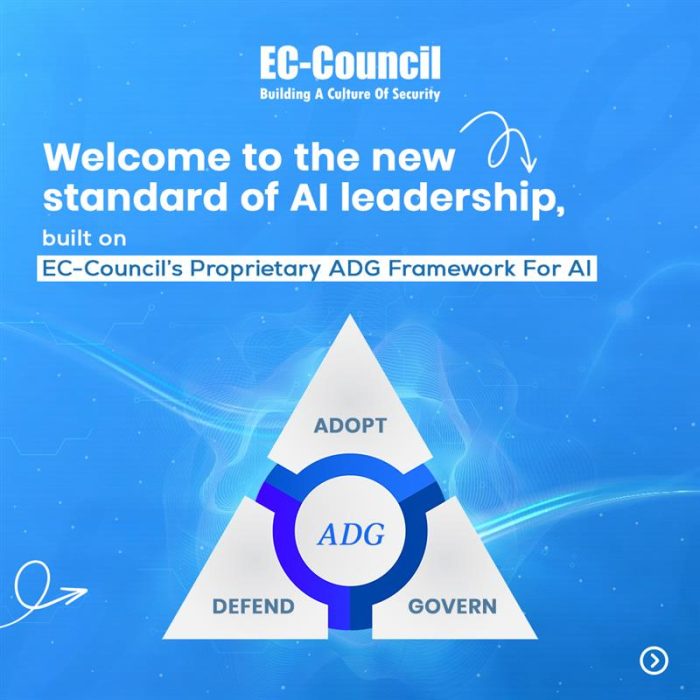
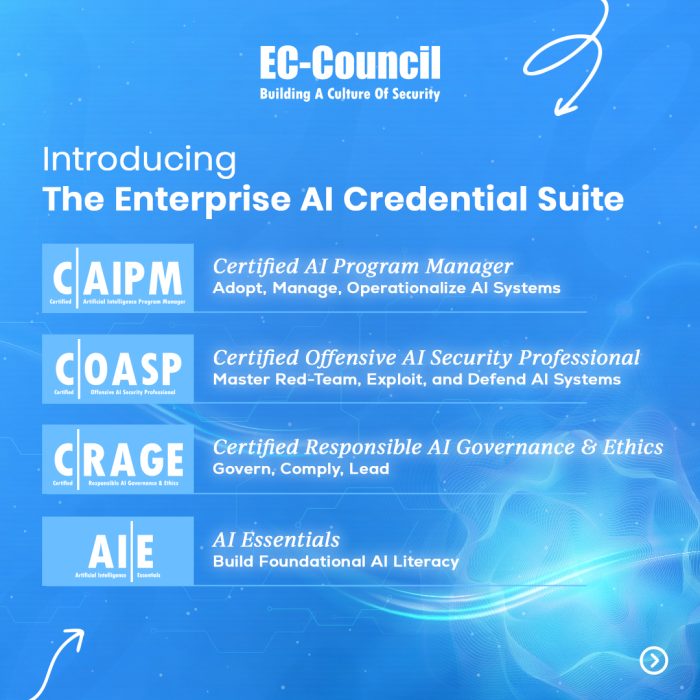


Recommended EC-Council AI Path — Adoption, Testing & Governance (ADG)
- 🤖 Level 1 – Foundations (AI Literacy) – Recommended Foundation
Artificial Intelligence Essentials (AIE) – Understand the basics of AI, its use cases, its limitations, and best practices for using it responsibly on a daily basis. - 📈 Level 2 – ADOPT (Piloting & Scaling) – Next step
Certified AI Program Manager (CAIPM) – Define and manage end-to-end AI initiatives: maturity, use case selection, roadmap, change management, operational governance, and value measurement. - 🛡️ Level 3 – DEFEND (Offensive AI Security) – Next step
Certified Offensive AI Security Professional (COASP) – Evaluate the security of AI systems from an attacker’s perspective: red teaming, LLM, prompt injection, attacks on applications/pipelines/agents, supply chain risks, then hardening and incident response. - ⚖️ Level 4 – GOVERN (AI Governance & Ethics) – You are here
Certified Responsible AI Governance & Ethics (CRAGE) – Governance, risk, compliance (EU AI Act / NIST AI RMF / ISO), privacy, assurance, audit. - 👔 Level 5 – Cybersecurity Leadership (C-suite) – Expert Achievement
Certified Chief Information Security Officer (CCISO) – Executive leadership, governance, strategy, finance, security program, board alignment, and leadership in addressing AI threats.
Duration and Salary Progression by Level
| Level | Certification | Duration | Average Salary (CAD) |
|---|---|---|---|
|
1 |
Artificial Intelligence Essentials |
2 days |
$70,000 – $120,000 (depending on the position: analyst, specialist, manager, etc.) |
|
2 |
Certified AI Program Manager |
3 days |
$120,000 – $170,000 (AI program management / transformation / TPM) |
|
3 |
Certified Offensive AI Security Professional |
5 days |
$130,000 – $190,000 (AI security / red team / advanced AppSec) |
|
4 |
Certified Responsible AI Governance & Ethics |
3 days |
$110,000 – $160,000 (AI governance / risk & compliance / audit) |
|
5 |
Certified Chief Information Security Officer |
5 days |
$170,000 – $260,000 (CISO / security director / cybersecurity director) |
- Total program duration: 6–18 months
- Potential salary increase: ~+125% from Level 1 to Level 5
Skills Development by Level
| Skill Area | AIE | CAIPM | COASP | CRAGE | CCISO |
|---|---|---|---|---|---|
|
AI culture (concepts, uses, limits) |
Mastered |
Advanced |
Advanced |
Advanced |
Advanced |
|
Adoption & transformation (maturity, use cases, roadmap) |
Concepts |
Mastered |
Concepts |
Advanced |
Advanced |
|
AI security (LLM applications, agents, pipelines, hardening) |
Awareness |
Concepts |
Mastered |
Advanced |
Advanced |
|
Governance / ethics / compliance (EU AI Act, NIST, ISO) |
Concepts |
Advanced |
Advanced |
Concepts |
Mastered |
|
Executive leadership (strategy, budget, governance, board of directors) |
Awareness |
Concepts |
Concepts |
Concepts |
Mastered |
Level 4 – GOVERN with FRAMEWORK (AI Governance and Ethics) (Your current stage)
Why this is your next logical step:
CRAGE consolidates the transition to responsible and audit-ready AI: governance framework, policies and controls, roles and responsibilities, risk management (bias, privacy, security, misuse), compliance requirements, and traceability. This is the step that enables the deployment and scaling of AI in production with defensible decisions, robust documentation, and ongoing oversight.
Typical roles :
- AI Governance Lead / Responsible AI Lead
- AI Compliance Lead / AI Risk & Compliance Advisor
- AI Data Protection & Ethics Lead / AI-led GRC Manager
Average salary in Canada : $110 000 – $160 000 CAD
Estimated training duration : 3–6 months
Level 5 – Cybersecurity Leadership (C-suite) with CCISO v4 (Consolidation Stage – Executive Level)
Building on AIE (foundations), CAIPM (corporate adoption), and CRAGE (governance & ethics), CCISO v4 takes you to the executive level: managing cyber risk, security strategy, governance, compliance, budgets, crisis management, and team leadership. This step positions AI as a risk and resilience issue at the organizational level, with executive decision-making and arbitration capabilities.
Back to Level 3 – DEFEND with COASP
Building on the foundations of AIE and CAIPM (foundations + enterprise deployment), COASP focuses on the offensive security of AI systems: LLM red teaming, prompt injection, attacks on applications, agents, and data pipelines, followed by hardening and incident response. This stage prepares you for specialized roles in “proof-of-test” securing of AI solutions in production.
Back to Level 2 – ADOPT with CAIPM
Return to CAIPM to structure the transition from pilot to production: ownership, maturity, prioritization of use cases, change management, integration and value measurement (ROI).
Back to Level 1 – Foundations with AIE
If you have not yet validated the Artificial Intelligence Essentials (AIE) certification, it is recommended to start with this step in order to acquire a common base: key concepts, use cases, limits, risks (e.g. leaks, hallucinations, prompt injection) and best practices for responsible use of AI on a daily basis.
Other Available EC-Council Pathways
After completing the AI – Adoption, Testing & Governance (ADG) track, you can also explore other specialized tracks or complementary certifications:
Ethical Hacking Technical Pathway
- Certified Ethical Hacker (CEH)
- Certified Network Defender (CND)
- Certified Penetration Testing Professional (CPENT)
Security Operations Center (SOC) Pathway
- Certified Cybersecurity Technician (CCT)
- Certified Security Analyst (CSA)
- EC-Council Certified Incident Handler (ECIH)
- Certified Threat Intelligence Analyst (CTIA)
Cybercrime Investigation Pathway
Leadership Pathway
Complementary Certifications
Benefits of the Complete Pathway
Structured Progression (ADG)
Each certification builds upon the previous one to develop comprehensive expertise: adopting AI, testing its robustness, governing its use, and then bringing the strategy to the executive level.
Market alignment (AI in production)
Designed to meet the real needs of organizations: accelerated deployment, real-world incidents (prompt injection, leaks, fraud) and compliance requirements.
Audit-ready governance
Develops the skills needed to implement assurance policies, controls and mechanisms aligned with reference frameworks (EU AI Act, NIST AI RMF, ISO).
Risk reduction through evidence
Validation-oriented approach: offensive testing, hardening and incident response preparation to secure AI systems before an incident occurs.
Career acceleration & credibility
Positions you for high-value roles (AI program, AI security, AI governance, cybersecurity leadership) with recognized and job-role-oriented certifications.
Ready to Advance?
Eccentrix Corner Articles: Certified Responsible AI Governance & Ethics (CRAGE) EC-6174 Resources
Explore our technical articles on Certified Responsible AI Governance & Ethics (CRAGE) published on Eccentrix Corner. These resources delve into the key concepts of responsible AI governance in an enterprise context and help you establish a robust, audit-ready framework, from policy to operations. You’ll find practical content on ethics, compliance, traceability, and documentation, as well as AI risk management (bias, privacy, security, and misuse) and defining roles and responsibilities. Our experts share concrete insights to help you manage AI solutions in production, ensure sound decision-making, and achieve CRAGE certification.



CRAGE EC-Council training - Certified Responsible AI Governance & Ethics EC-6174
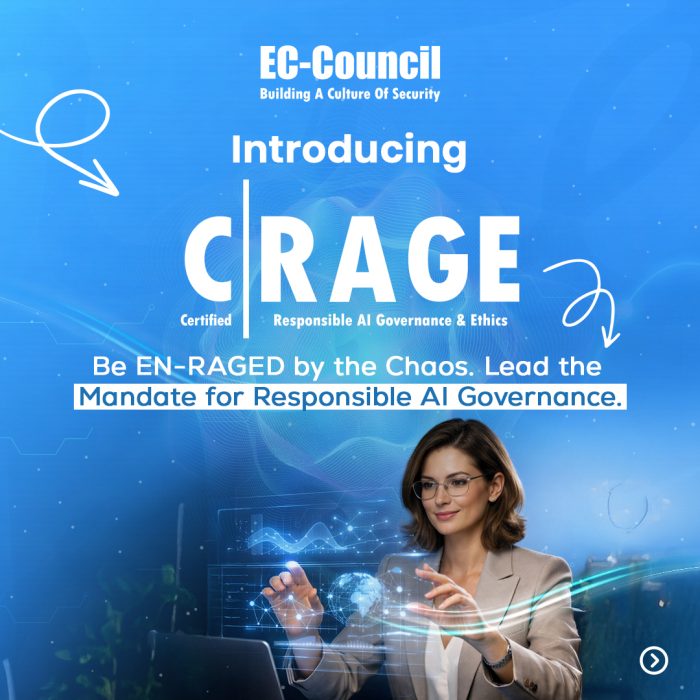
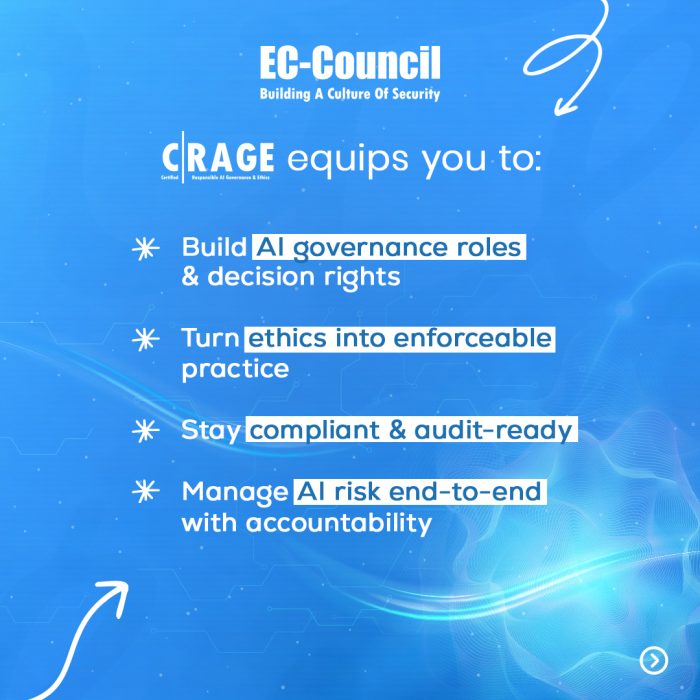
The Certified Responsible AI Governance & Ethics (CRAGE) (EC-6174) course prepares professionals to guide and govern enterprise-wide artificial intelligence initiatives with a structured approach focused on ethics, compliance, risk management, and auditability. This course addresses a very real challenge: many organizations are accelerating their adoption of AI but struggle to deploy it sustainably without a clear governance framework, which exposes them to risks of bias, non-compliance, privacy breaches, security incidents, and decisions that are difficult to justify. CRAGE bridges this gap by providing you with the methods to define robust rules of engagement, secure decision-making, and demonstrate defensible governance to stakeholders and auditors.
Participants learn to establish a Responsible AI Governance framework (policies, roles and responsibilities, committees, processes), identify and address AI risks (bias, privacy, security, misuse), implement appropriate controls and traceability, and document decisions to support compliance and trust. The CRAGE certification validates sought-after skills: AI governance and ethics, compliance and GRC applied to AI, risk management, transparency/explainability requirements, documentation and audit readiness, and ongoing monitoring of AI systems in production.
Why choose CRAGE training?
AI has moved from experimentation to infrastructure, but the failure (or stalling) of many initiatives rarely stems from the technology itself: it often comes from a lack of governance framework, clear responsibilities, controls, traceability, and an inability to demonstrate that decisions are ethical, compliant, and defensible. CRAGE prepares you to play the role of guardian of responsible AI: structuring AI governance and ethics, defining the rules of the game (policies, standards, processes), and mitigating risks related to bias, privacy, security, and misuse, all while fostering stakeholder trust.
Earning the Certified Responsible AI Governance & Ethics (CRAGE) certification demonstrates your ability to manage AI at scale with an audit-ready approach: implementing controls and oversight mechanisms, documenting decisions, managing AI risks throughout the entire lifecycle, and aligning with the organization’s compliance and governance requirements.
Skills developed during training
Responsible AI Governance: Audit-Ready
Learn to structure an AI governance framework (principles, policies, roles, committees, processes) and produce clear evidence to support compliance and audits.AI Ethics and Bias Management
Develop methods to identify, assess, and mitigate bias, enhance fairness, and guide responsible decision-making throughout the AI systems lifecycle.AI Compliance and Regulatory Requirements
Translate requirements (internal and external) into operational controls: documentation, validations, approvals, traceability, and vendor governance.AI Risk Management (Confidentiality, Security, Misuse, Usage)
Implement a structured approach to managing AI-specific risks: data protection, security, model misuse, non-compliant usage, and business impacts.Controls, Traceability, and Documentation of Decisions
Master control and traceability mechanisms (logging, justification, exception handling) to make AI decisions and deployments defensible.Continuous Monitoring and Production Governance
Define production monitoring mechanisms: risk indicators, performance monitoring, periodic reviews, incident management, and continuous improvement.- Responsibilities, Stakeholders, and Operating Model
Clarify ownership (who decides, who approves, who operates), align IT, security, legal, HR, and business, and structure an AI governance operating model.
- Communication and Assurance with Stakeholders
Learn to communicate risks, controls, limits, and decisions clearly to executives, operational teams, and control functions to strengthen buy-in.
Instructor-led training with business-oriented exercises
The CRAGE training is based on concrete exercises throughout the course (AI risk mapping, definition of policies and safeguards, clarification of roles and responsibilities, compliance requirements, controls and traceability, bias management, data protection, exception management, audit preparation, production supervision, etc.) in order to prepare you to manage AI systems in real contexts and to make decision-making defensible.
Who is this training for?
This training is ideal for:
- Governance, Risk, and Compliance (GRC) officers who need to oversee AI
- Security and data protection (privacy) leaders involved in AI in production
- Legal, compliance, internal audit, and operational risk management officers
- AI product/platform managers who need to integrate controls and traceability
- IT and digital transformation leaders who want to deploy AI with a responsible AI framework
- Data/analytics managers and architects who are moving into AI oversight and governance roles
Strengthen your ability to govern AI responsibly with CRAGE
The Certified Responsible AI Governance & Ethics (CRAGE) (EC-6174) training program provides you with a comprehensive methodology for governing AI across the enterprise: principles and policies, roles and responsibilities, risk management (bias, privacy, security, misuse), controls, traceability, and audit-ready documentation. Enroll to earn a recognized certification and accelerate your career progression toward roles where governance and compliance make AI sustainable, acceptable, and defensible.
Exam Success Strategies for CRAGE
Passing the CRAGE certification requires more than a “theoretical” understanding of AI: it demands structured preparation focused on governance, ethics, compliance, risk management, and auditability. By mastering key concepts (governance frameworks, responsibilities, controls, traceability, bias management, data protection, production monitoring), and practicing on business scenarios (risk assessment, policy definition, compliance vs. performance trade-offs, exception handling, incidents, and remediation), you develop the reflexes needed to answer exam questions effectively—and, most importantly, to apply these principles in real-world environments.
CRAGE Exam Statistics and Success Rates
- Average success rate: 70–80% on the first attempt
- Most common score range: 72–82% for successful candidates
- Average study time: 4–6 weeks (experienced IT/cybersecurity/GRC profile); 6–8 weeks (more business-oriented profile or less exposed to compliance/risk)
- Retake rate: 15–25% of candidates require a second attempt
- Main areas of failure: Responsible AI governance, ethics, compliance, and risk management (28%); traceability, audit-ready documentation, and production monitoring (22%); data protection (privacy), access management, and security requirements (18%); bias management, transparency/explainability, and risk vs. performance trade-offs (16%); operating model, roles and responsibilities (RACI), exception handling, and stakeholder communication (16%).
Study Method Comparison
| Study Approach | Duration | Pass rate | Best for |
|---|---|---|---|
|
Hands-on Practice Only |
6-8 weeks |
45–55% |
Profiles already exposed to AI/GRC governance |
|
Documentation + Practice |
8-10 weeks |
65–75% |
Methodical learners (policies, controls, compliance) |
|
Training + Labs + Practice |
4-6 weeks |
80-90% |
Complete preparation + real-world case studies + business application |
|
Practice Tests Only |
3-4 weeks |
30-40% |
Not recommended (deficiencies regarding compliance, risks, auditability) |
Strategic Study Approach
- Create a modular study plan: AI fundamentals & risks → ethics & bias → privacy & data → governance (roles/RACI, policies) → controls & traceability → compliance & audit → production monitoring & continuous improvement.
- Study in “decision-making” mode: for each concept, practice answering “what risk, what control, what evidence, who validates, and what monitoring mechanism?”
- Apply a 60-30-10 rule: 60% scenarios/exercises, 30% structured review, 10% exam-style questions.
- Produce mini-deliverables: AI risk register, RACI/operating model, AI usage policy, compliance checklist, bias/impact matrix, traceability requirements, monitoring plan, AI incident management procedure.
- Practice handling exceptions: when to accept a risk, when to block it, what compensation is required, and what approvals are needed.
- Simulate executive communication: summarize in 60 seconds “risks → controls → evidence → status → next actions”.
Common Exam Pitfalls to Avoid
- Confusing “ethics” and “compliance”: the exam tests your ability to operationalize both through policies, controls, and evidence.
- Thinking in terms of “principles” without mechanisms: a principle without controls, traceability, and ownership is not audit-ready.
- Underestimating privacy: data, consent, data minimization, access, retention, logging.
- Forgetting traceability: decisions, versions, exceptions, validations, evidence.
- Neglecting production monitoring: deviations, incidents, periodic reviews, remediation.
Topic Weight Distribution
| Exam domain | Weight | Focus Areas | Priority |
|---|---|---|---|
|
AI Foundations & Risks in a Business Context (AI/GenAI, limitations, failure modes, lifecycle) |
10-14% |
Key concepts, limitations, typical risks, life cycle and control points |
High |
|
Responsible AI governance (framework, policies, operating model) |
14-18% |
Principles, policies, roles, committees, RACI, decision-making processes, exception management |
Critical |
|
Ethics applied to AI & bias management |
12-16% |
Bias, fairness, impacts, transparency, explainability, trade-offs and remediation |
Critical |
|
Compliance & regulatory requirements (AI + data) |
12-18% |
Internal/external requirements, obligations, evidence, audit, supplier governance |
Critical |
|
Data protection (privacy) & data governance |
10-14% |
Minimization, consent, classification, access, retention, logging, DPIA/impact assessments (depending on context) |
High |
|
AI system security (controls, access, threats, hardening) |
8-12% |
Security controls, IAM, segmentation, application security, risks related to models and integrations |
High |
|
Traceability, documentation & auditability (“audit-ready”) |
12-16% |
Documentation of decisions, evidence, logs, versioning, exception handling, justification |
Critical |
|
Production supervision & continuous improvement |
8-12% |
Monitoring, deviations, periodic reviews, incidents, remediation, continuous governance |
High |
|
Communication, assurance and stakeholder management |
6-10% |
Executive communication, risk/control reporting, IT-security-legal-business alignment |
Medium |
Exam Day Time Management
- Perform a quick initial review: answer the obvious questions first, then mark those requiring further analysis (don’t get stuck).
- Immediately identify the context: risk/ethics, compliance, privacy, governance (RACI/policies), controls & traceability, or production monitoring.
- Look for keywords that guide the correct answer: governance, responsible AI, compliance, audit, traceability, evidence, bias, explainability, privacy, access, exceptions, monitoring, incident.
- Eliminate “good but incomplete answers”: prioritize the most audit-ready option (clear ownership + control + evidence + monitoring mechanism).
- Manage your pace: maintain a steady rhythm, avoid over-analyzing; if two choices seem similar, choose the one that clarifies responsibilities, reduces risk, and strengthens traceability.
- Set aside 10 to 15 minutes at the end to revisit the marked questions, reread calmly, and verify the consistency of your answers.
- Beware of “scenario” questions: first read the complete situation, then the question, then the choices — the details (data, constraints, risks, stakeholders) often make the difference.
Managing Exam Stress & Performance
- Sleep 7 to 8 hours the night before: avoid last-minute cramming, which reduces clarity of judgment (especially on scenario questions).
- Prepare your environment: stable connection, quiet space, water within reach, everything ready before you start to minimize mental strain.
- Arrive/Log in 5 to 10 minutes early: take the time to settle in and start the exam in a stable state.
- Use a simple breathing technique if the pressure rises: inhale for 4 seconds, hold for 2 seconds, exhale for 6 seconds (2–3 cycles are sufficient).
- Return to the CRAGE framework when a question throws you off: risk → governance & responsibilities → controls → traceability/evidence → supervision & remediation.
- Don’t get stuck: mark the question, move on to the next one, then come back to it with a fresh mind.
- Trust your logic: the exam rewards the most audit-ready answer (clear ownership + control + evidence + monitoring mechanism).
- Remember the passing grade: you don’t need to be perfect, but you do need to be solid and consistent in your governance, risk reduction, and auditability.
Technical Preparation Tips
- Master the enterprise AI system lifecycle: from ideation to testing, then from deployment to production monitoring (incident management, continuous improvement).
- Understand the fundamentals of MLOps/DataOps (governance level): why these practices exist, what they secure (quality, reproducibility, versioning, deployment, monitoring), and how they support traceability.
- Practice evaluating AI platforms and tools: selection criteria (IT integration, security, confidentiality, compliance, logging, costs, vendor maturity, dependencies).
- Strengthen responsible AI governance: policies, roles/RACI matrix, auditability/traceability, bias management, regulatory requirements, security controls.
- Work on key trade-offs: performance vs. risk, speed vs. compliance, automation vs. human oversight, internal vs. external data, permitted vs. prohibited use.
- Practice the “governance & risk” measurement: distinguish between compliance indicators (evidence, exceptions, validations), risk indicators (incidents, deviations, biases), and monitoring indicators (monitoring, remediation).
- Simulate integration in a real-world environment: data dependencies, access/identity, logging, model governance, change management, support, and operations.
- Prepare a mini “deliverables kit”: AI risk register, RACI/operating model, AI usage policy, traceability requirements, compliance checklist, monitoring plan, and AI incident management procedure.
Final Week Preparation
- Conduct 2 to 3 complete “block” reviews: governance & responsibilities → compliance & privacy → controls & traceability → bias & ethics → production monitoring & incidents.
- Revisit your mini-deliverables (even in a simplified version): AI risk register, RACI/operating model, responsible AI policy, traceability requirements, compliance checklist, monitoring plan.
- Strengthen your weak points: responsible AI governance, traceability/auditability, privacy, bias/fairness, production monitoring, and exception handling.
- Practice scenario-based questions: for each answer, force yourself to justify it in 1-2 sentences (risk + control + evidence + ownership + follow-up).
- Review key vocabulary: governance, compliance, audit-ready, traceability, evidence, privacy, bias, explainability, operating model, exceptions, monitoring, incident response.
- Streamline your monitoring: avoid new concepts. Do a short revision, prepare your environment and go to bed early to arrive alert.
Mental Preparation Strategies
- Visualize success scenarios: Imagine yourself leading an AI use case (risks → governance → controls → evidence → oversight) and calmly answering the scenario questions.
- Adopt a business decision mindset: The exam isn’t looking for the most technical answer, but the most governed, compliant, and defensible one.
- Establish a simple, repeatable framework: Risks → Governance → Controls → Evidence → Oversight. If you’re unsure, return to this sequence.
- Build confidence with small wins: Each day, end with a short deliverable (e.g., mini risk register, mini RACI matrix, mini evidence/traceability checklist) rather than passively reviewing.
- Manage energy, not just time: 60–90 minute blocks, short breaks, and hydration. Avoid overly long sessions, as they diminish the quality of the analysis.
- Embrace uncertainty: some questions will be intentionally ambiguous; your goal is to choose the most audit-ready option, not to be perfect.
- On the day of the exam, remain factual: if a question throws you off, take a breath, make a note of it, move on to the next one, and then return to it with a clearer mind.
How to Schedule Your CRAGE Exam
- The tests are taken online via the ECC Exam Portal (EC-Council exam platform).
- Scheduling process: Create an account, search for “CRAGE” or “612-51,” and then select your date.
- Exam cost: Included in your Eccentrix training – an exam voucher is provided for this certification.
- Scheduling calendar: Book at least 1 to 2 weeks in advance for the best availability of exam slots.
- Rescheduling policy: Free rescheduling up to 24 hours before your exam appointment.
- Required ID: Government-issued photo identification (passport, driver’s license) that exactly matches your registration name.
Success mindset: Approach the CRAGE certification as a validation of your ability to govern AI responsibly—ethics, compliance, risk management, controls, traceability, and oversight—not as a simple test of definitions. Your greatest asset is your ability to make structured and defensible decisions: clarifying responsibilities, framing risks, demanding evidence, managing exceptions, and ensuring production oversight.
Frequently asked questions
What are the prerequisites for the CRAGE (CRAGE) training?
Relevant professional experience is recommended. No programming is required, but familiarity with generative AI and basic concepts in governance, compliance, and risk management is an asset.
What topics are covered in the CRAGE course?
The training covers responsible AI governance and applied ethics: frameworks and policies, roles and responsibilities, compliance, AI risk management (bias, confidentiality, security, drift), controls, traceability and audit-ready documentation, as well as continuous monitoring of AI systems in production.
Does the training include practical exercises and business scenarios?
Yes. Participants work on realistic scenarios (risk mapping, policy and safeguard definition, RACI/operating model, traceability requirements, exception management, audit preparation, supervision and remediation) in order to be able to apply the concepts in concrete organizational contexts.
Is this certification business-oriented or technically oriented?
CRAGE is primarily focused on governance, risk, and compliance. It does not aim to train AI development specialists, but rather to provide enterprise-ready decision-making and management capabilities for AI systems used in production.
How does CRAGE help to guide AI deployed in production in a responsible manner?
CRAGE teaches you how to implement a governance framework and concrete controls: clear responsibilities, usage policies, data protection requirements, bias management, decision traceability, and continuous monitoring. The goal is to make AI defensible, compliant, and audit-ready throughout its entire lifecycle.
How can CRAGE certification benefit my career?
CRAGE strengthens your credibility on critical issues (responsible AI, compliance, auditability, risk management) and positions you for high-value roles: AI governance, AI-oriented GRC, compliance/risk, privacy, security and supervision of AI systems in production.