
Training plan
Module 1: Offensive AI and AI System Hacking Methodology
- Understand AI and machine learning fundamentals from an offensive security perspective
- Identify AI attack surfaces, threat landscapes, and adversary techniques aligned to MITRE ATLAS
- Apply AI system hacking methodologies, frameworks, and risk implications
- Classify AI attack taxonomies and models
- Define offensive AI scoping fundamentals and foundations for securing AI systems
- Provide an overview and mapping of OWASP LLM & ML Top 10 (2025) to AI threats and governance considerations
Module 2: AI Reconnaissance and Attack Surface Mapping
- Apply OSINT tools and techniques to identify and profile AI assets
- Gather intelligence from AI data sources and training pipelines
- Discover and map AI attack surfaces using publicly available intelligence
- Enumerate AI endpoints, services, APIs, and exposed parameters
- Identify and analyze AI models and vector stores from an attacker’s perspective
- Evaluate OSINT exposure and apply hardening controls to reduce risk
- Use AI threat intelligence to support continuous monitoring and defensive readiness
Module 3: AI Vulnerability Scanning and Fuzzing
- Understand core principles of AI vulnerability assessment and threat discovery
- Use tools and techniques for scanning vulnerabilities in AI models, pipelines, and deployments
- Apply practical fuzzing methods tailored for AI systems and model interfaces
- Integrate scanning and fuzzing into AI security workflows for proactive risk mitigation
Module 4: Prompt Injection and LLM Application Attacks
- LLM architecture, trust boundaries, and associated attack vectors
- Execute prompt injection and jailbreaking techniques in real-world LLM applications
- Identify sensitive information disclosure and system prompt leakage risks
- Evaluate improper output handling vulnerabilities and misinformation threats
- Apply advanced prompt-based attack techniques and exploitation strategies
- Implement secure LLM application design principles and defensive controls
Module 5: Adversarial Machine Learning and Model Privacy Attacks
- Identify core adversarial machine learning attack classes
- Execute practical adversarial input attacks across data modalities
- Apply privacy, inference, and model extraction attack techniques
- Evaluate robustness, trustworthiness, and risk evaluation methods
- Implement defensive strategies for model privacy and resilience
Module 6: Data and Training Pipeline Attacks
- Understand AI data and training pipeline architecture and threat surfaces
- Execute practical data poisoning techniques and attack scenarios
- Apply backdoor and trojan insertion during model training
- Implement security measures to safeguard data and training pipelines
Module 7: Agentic AI and Model-to-Model Attacks
- Understand agentic AI architecture and attack surface
- Apply excessive agency and autonomy exploitation techniques
- Identify cross-LLM and model-to-model attack vectors
- Asses denial-of-wallet risks and unbounded resource consumption
- Execute attacks targeting AI workflows and orchestration layers
- Implement defensive strategies for securing agentic AI applications
Module 8: AI Infrastructure and Supply Chain Attacks
- Understand AI infrastructure components and system integration architectures
- Identify vulnerabilities in AI systems, frameworks, and deployment pipelines
- Analyze abuse of tools, plugins, and APIs in AI-enabled applications
- Assess AI supply chain threats and dependency risks (deep dive)
- Implement hardening strategies for AI infrastructure and supply chains
Module 9: AI Security Testing, Evaluation, and Hardening
- Understand AI security testing methodologies and evaluation techniques
- Apply red team frameworks for offensive AI assessment
- Identify, validate, and report AI vulnerabilities and risk
- Implement security hardening and mitigation best practices for AI systems
Module 10: AI Incident Response and Forensics
- Detect and respond to AI-specific security incidents
- Collect and analyze AI logs, telemetry, and digital evidence
- Analyze root causes in post-incident analysis

Recommended prerequisite knowledge
- Relevant professional experience (IT, cybersecurity, program/project management, digital transformation, or business functions) is recommended.
- No programming experience is required (business-led profile, focused on steering and governance).
- Familiarity with AI concepts, particularly generative AI (use cases, limitations, risks), is recommended.
- Basic knowledge of prompt engineering (principles and best practices) is recommended.
- A general understanding of enterprise AI workflows (adoption, deployment, scaling) is an asset for success.
Credentials and certification
Exam features
- Code: 312-52
- Title: Certified Offensive AI Security Professional (COASP)
- Duration: 6 hours
- Number of Questions: 70
- Question Format: Multiple Choice
- Online with EC-Council Exam Center
- Cost: $0 (included in your training)
EC-Council Career Advancement Pathway
Eccentrix offers a structured EC-Council certification path to specialize in AI adoption, testing, and governance. This path is designed to address market realities (accelerated adoption, real-world incidents, compliance requirements) and to align your skills with the roles that drive AI in production, securely and audit-ready.
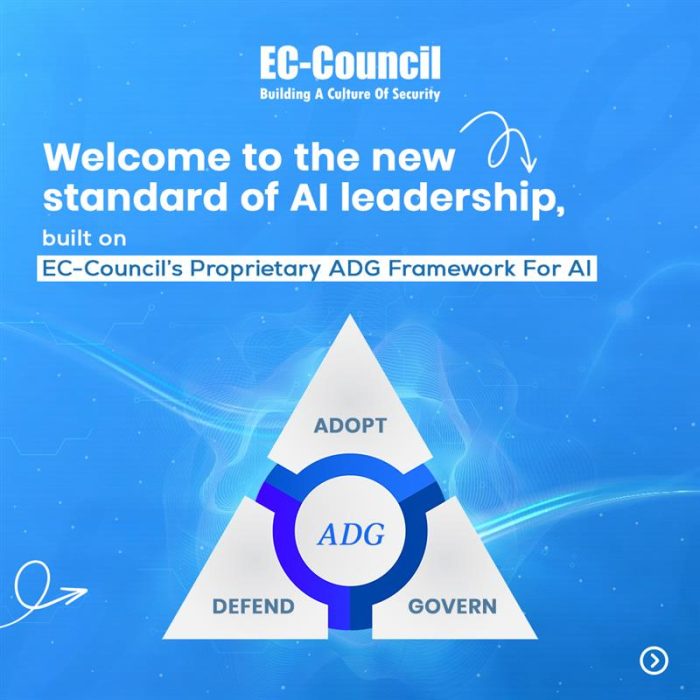
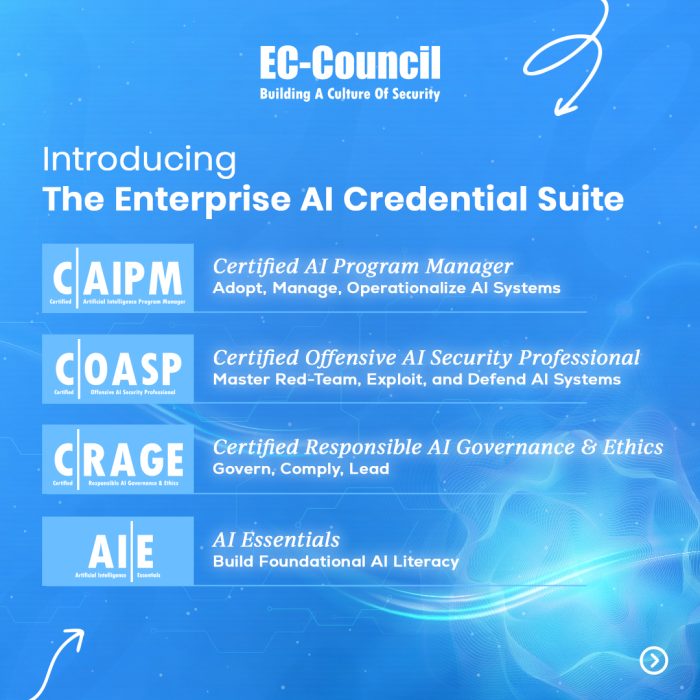


Recommended EC-Council AI Path — Adoption, Testing & Governance (ADG)
- 🤖 Level 1 – Foundations (AI Literacy) – Recommended Foundation
Artificial Intelligence Essentials (AIE) – Understand the basics of AI, its use cases, its limitations, and best practices for using it responsibly on a daily basis. - 📈 Level 2 – ADOPT (Piloting & Scaling) – Next step
Certified AI Program Manager (CAIPM) – Define and manage end-to-end AI initiatives: maturity, use case selection, roadmap, change management, operational governance, and value measurement. - 🛡️ Level 3 – DEFEND (Offensive AI Security) – You are here
Certified Offensive AI Security Professional (COASP) – Evaluate the security of AI systems from an attacker’s perspective: red teaming, LLM, prompt injection, attacks on applications/pipelines/agents, supply chain risks, then hardening and incident response. - ⚖️ Level 4 – GOVERN (AI Governance & Ethics) – Next Step
Certified Responsible AI Governance & Ethics (CRAGE) – Governance, risk, compliance (EU AI Act / NIST AI RMF / ISO), privacy, assurance, audit. - 👔 Level 5 – Cybersecurity Leadership (C-suite) – Expert Achievement
Certified Chief Information Security Officer (CCISO) – Executive leadership, governance, strategy, finance, security program, board alignment, and leadership in addressing AI threats.
Duration and Salary Progression by Level
| Level | Certification | Duration | Average Salary (CAD) |
|---|---|---|---|
|
1 |
Artificial Intelligence Essentials |
2 days |
$70,000 – $120,000 (depending on the position: analyst, specialist, manager, etc.) |
|
2 |
Certified AI Program Manager |
3 days |
$120,000 – $170,000 (AI program management / transformation / TPM) |
|
3 |
Certified Offensive AI Security Professional |
5 days |
$130,000 – $190,000 (AI security / red team / advanced AppSec) |
|
4 |
Certified Responsible AI Governance & Ethics |
3 days |
$110,000 – $160,000 (AI governance / risk & compliance / audit) |
|
5 |
Certified Chief Information Security Officer |
5 days |
$170,000 – $260,000 (CISO / security director / cybersecurity director) |
- Total program duration: 6–18 months
- Potential salary increase: ~+125% from Level 1 to Level 5
Skills Development by Level
| Skill Area | AIE | CAIPM | COASP | CRAGE | CCISO |
|---|---|---|---|---|---|
|
AI culture (concepts, uses, limits) |
Mastered |
Advanced |
Advanced |
Advanced |
Advanced |
|
Adoption & transformation (maturity, use cases, roadmap) |
Concepts |
Mastered |
Concepts |
Advanced |
Advanced |
|
AI security (LLM applications, agents, pipelines, hardening) |
Awareness |
Concepts |
Mastered |
Advanced |
Advanced |
|
Governance / ethics / compliance (EU AI Act, NIST, ISO) |
Concepts |
Advanced |
Advanced |
Concepts |
Mastered |
|
Executive leadership (strategy, budget, governance, board of directors) |
Awareness |
Concepts |
Concepts |
Concepts |
Mastered |
Level 3 – DEFEND with COASP (AI Offensive Security) (Your current stage)
Why this is your logical next step:
COASP takes you from “AI used in production” to “AI tested as a target”: reconnaissance and mapping of attack surfaces (LLM apps, APIs, RAGs, agents, pipelines), exploitation of AI vulnerabilities (prompt injection, jailbreaking, data poisoning, model extraction, agent hijacking), and then validation and hardening of controls (guardrails, filtering, sandboxing, rate limiting, detection, IR playbooks). This is the step that allows you to secure AI through proof—by demonstrating that the defenses hold up against realistic attacks before (and after) deployment.
Typical roles:
- AI Red Team Specialist / Offensive Security Engineer (AI/LLM)
- Application Security Engineer (LLM Apps/APIs) / Product Security (AI)
- AI Threat Hunter / DFIR – Incident Response & AI Forensics
Average salary in Canada: $130 000 – $190 000 CAD
Estimated training duration: 3–6 months of training
Level 4 – GOVERN with CRAGE (Recommended next step)
After COASP, consolidate responsible AI governance with CRAGE: policies and controls, roles and responsibilities, compliance, traceability, audit-ready documentation and sustainable supervision of AI systems in production.
Level 5 – Cybersecurity Leadership with CCISO (Consolidation Stage – Executive Level)
Building on AIE (foundations), CAIPM (enterprise adoption), COASP (offensive security), and CRAGE (governance & ethics), CCISO guides you to the executive level: cyber risk management, security strategy, governance, compliance, budgets, crisis management, and team leadership. This stage positions AI as a risk and resilience issue at the organizational level, with executive decision-making and arbitration capabilities.
Back to Level 2 – ADOPT with CAIPM
Return to CAIPM to structure the transition from pilot to production: ownership, maturity, prioritization of use cases, change management, integration and value measurement (ROI).
Back to Level 1 – Foundations with AIE
If you have not yet validated the Artificial Intelligence Essentials (AIE) certification, it is recommended to start with this step in order to acquire a common base: key concepts, use cases, limits, risks (e.g. leaks, hallucinations, prompt injection) and best practices for responsible use of AI on a daily basis.
Other Available EC-Council Pathways
After completing the AI – Adoption, Testing & Governance (ADG) track, you can also explore other specialized tracks or complementary certifications:
Ethical Hacking Technical Pathway
- Certified Ethical Hacker (CEH)
- Certified Network Defender (CND)
- Certified Penetration Testing Professional (CPENT)
Security Operations Center (SOC) Pathway
- Certified Cybersecurity Technician (CCT)
- Certified Security Analyst (CSA)
- EC-Council Certified Incident Handler (ECIH)
- Certified Threat Intelligence Analyst (CTIA)
Cybercrime Investigation Pathway
Leadership Pathway
Complementary Certifications
Benefits of the Complete Pathway
Structured Progression (ADG)
Each certification builds upon the previous one to develop comprehensive expertise: adopting AI, testing its robustness, governing its use, and then bringing the strategy to the executive level.
Market alignment (AI in production)
Designed to meet the real needs of organizations: accelerated deployment, real-world incidents (prompt injection, leaks, fraud) and compliance requirements.
Audit-ready governance
Develops the skills needed to implement assurance policies, controls and mechanisms aligned with reference frameworks (EU AI Act, NIST AI RMF, ISO).
Risk reduction through evidence
Validation-oriented approach: offensive testing, hardening and incident response preparation to secure AI systems before an incident occurs.
Career acceleration & credibility
Positions you for high-value roles (AI program, AI security, AI governance, cybersecurity leadership) with recognized and job-role-oriented certifications.
Ready to Advance?
Eccentrix Corner Articles: Certified Offensive AI Security Professional (COASP) EC-6176 Resources
Explore our technical articles on Certified Offensive AI Security Professional (COASP) published on Eccentrix Corner. These resources delve into key concepts of offensive security applied to AI and help you structure a repeatable AI red teaming approach, from reconnaissance to defense validation. You’ll find practical content on vulnerabilities in LLM and AI applications (prompt injection, jailbreaking, data leaks), attacks on agents and workflows, risks associated with data pipelines (data poisoning), and hardening approaches (guardrails, controls, detection, monitoring). Our experts share concrete insights to help you test AI “by proof,” produce actionable results (findings, recommendations, artifacts), and successfully complete the COASP certification.



COASP - Certified Offensive AI Security Professional training EC-6176
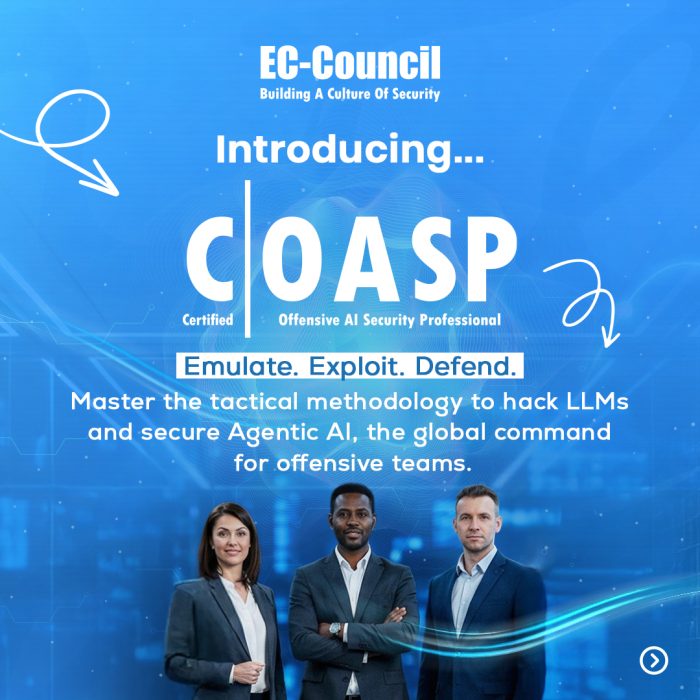
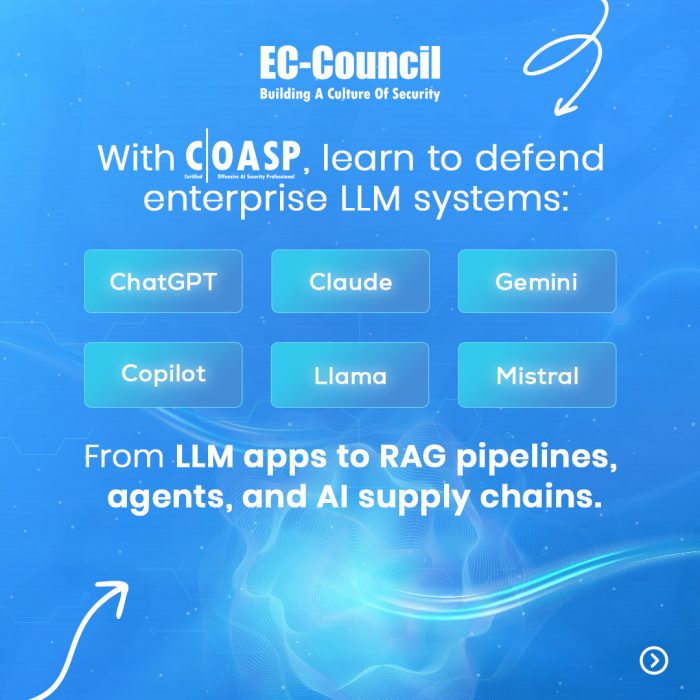
EC-Council’s Certified Offensive AI Security Professional (COASP) course prepares cybersecurity professionals to test and secure AI systems in real-world conditions, using a structured approach focused on AI red teaming and control validation. This course addresses a very real challenge: LLMs, AI applications, and agents are opening up new attack paths (prompts, models, data pipelines, APIs, integrations) that traditional penetration testing methods don’t fully cover. COASP bridges this gap by providing a repeatable methodology for mapping, exploiting, and documenting AI vulnerabilities, then hardening defenses and strengthening detection.
Participants learn to conduct end-to-end offensive testing: AI attack surface reconnaissance and mapping, exploitation (prompt injection, jailbreaking, agent attacks, data poisoning, model extraction), and then validation of controls and production of actionable artifacts (evidence, recommendations, SOC-ready elements). The COASP certification validates sought-after skills: red teaming LLM/agentic AI, adversarial ML, pipeline and supply chain security, hardening, and AI incident detection and response.
Why choose COASP training?
AI has moved from experimentation to infrastructure, but the risks don’t just come from the models themselves: they stem from trust boundaries (prompts, tools, agent memory), integrations (APIs, plugins), data (poisoning), and security that is often untested “like an adversary.” COASP prepares you to play the role of AI red teamer: identifying vulnerabilities specific to LLM and agents, demonstrating realistic exploit scenarios, and then transforming these findings into production-ready defenses.
Earning the Certified Offensive AI Security Professional (COASP) certification demonstrates your ability to ethically attack AI systems, validate the robustness of controls, and deliver actionable results (evidence, prioritization, hardening recommendations, detection/IR elements) throughout the lifecycle.
Skills developed during the training
AI Hacking Methodology (RECON → EXPLOIT → DEFEND)
Learn a structured approach to end-to-end AI testing: reconnaissance, exploitation, validation, and hardening of controls.AI Reconnaissance and Attack Surface Mapping
Identify and analyze AI assets (models, APIs, RAGs, agents, pipelines, integrations) and prioritize points of exposure.Prompt Injection, Jailbreaking, and LLM Application Attacks
Master attacks on LLM trust boundaries: bypassing safeguards, manipulating outputs, data leaks, and design flaws.Adversarial ML Attacks & Privacy (Extraction/Privacy)
Assess robustness and risk through adversarial attacks, model extraction, and privacy breach scenarios.Data and Training Pipeline Attacks (Data Poisoning/Backdoors)
Test the integrity of data and training pipelines: poisoning, backdoor insertion, and preparation chain compromise.Agent Security and Multi-Model Architectures (Agentic AI)
Analyze and exploit autonomous agents: tool hijacking, memory corruption, orchestration manipulation, and denial-of-wallet risks.- AI Supply Chain & Infrastructure (Tools, Dependencies, Integrations)
Assess the risks associated with dependencies, third-party models, datasets, plugins, and integrated services, and then apply hardening strategies.
- AI Hardening, Detection, and Incident Response (SOC-Ready)
Transform offensive into defensive: engineering controls, detection rules, IR playbooks, log/telemetry collection, and AI forensics.
Instructor-led training with business-oriented exercises
The COASP training relies on concrete exercises throughout the course (attack mapping, AI scanning/fuzzing, prompt injection/jailbreaking, agent attacks, data poisoning, model extraction, control validation, hardening, incident detection and response) to prepare you to test AI “by proof” and deliver actionable results in real-world contexts.
Who is this training for?
This training is ideal for:
- Pentesters/ethical hackers and red team operators
- Offensive security and application security engineers (LLM apps/APIs)
- SOC analysts (Tier 2/3), detection engineers, and AI-focused threat hunters
- DFIR/incident response professionals who handle AI incidents
- DevSecOps/product security professionals involved in AI products in production
- AI/ML professionals (MLOps, GenAI engineers) who want to master offensive AI security
Strengthen your ability to secure AI with evidence using COASP
The Certified Offensive AI Security Professional (COASP) training program provides you with a comprehensive methodology for testing and hardening AI systems: reconnaissance, exploitation, control validation, hardening, incident detection, and response. Enroll to earn a recognized certification and accelerate your career progression toward roles where offensive security becomes a key driver of resilience for AI in production.
Exam Success Strategies for COASP
Earning the Certified Offensive AI Security Professional (COASP) certification requires more than just a theoretical understanding of LLMs: it demands structured preparation focused on realistic attacks, proof, and hardening. By mastering a RECON → EXPLOIT → DEFEND approach and practicing on near-production scenarios (LLM apps, RAGs, agents, APIs, data pipelines), you develop the reflexes needed to answer exam questions effectively—and, most importantly, to apply techniques in real-world environments.
The goal isn’t to memorize definitions, but to think like an AI red teamer: identify the attack surface, choose the right technique, demonstrate the impact, and then recommend controls and detection measures.
COASP Statistics and Success Rates
- Average success rate: 70–80% on the first attempt
- Most common score range: 72–82% for successful candidates
- Average study time: 4–6 weeks (experienced IT/cybersecurity/management profile); 6–8 weeks (more “business” profile or less exposed to governance/risk)
- Retake rate: 15–25% of candidates require a second attempt
- Main areas of failure: Prompt injection/jailbreaking and LLM trust boundaries (28%), agent security (tools, memory, permissions) and action hijacking (22%), RAG & data security (leaks, access control, data poisoning) (18%), adversarial ML & privacy (extraction, membership inference, robustness) (16%), hardening/detection/IR “SOC-ready” (16%).
Comparison of study methods
| Study Approach | Duration | Pass rate | Best For |
|---|---|---|---|
|
Hands-on Practice Only |
6-8 weeks |
45–55% |
Professionals already exposed to penetration testing/red teaming or application security (solid foundations, but need to align with LLM/RAG/agents) |
|
Documentation + Practice |
8-10 weeks |
65–75% |
Methodical learners who want to consolidate the methodology (RECON→EXPLOIT→DEFEND) and AI scenarios |
|
Training + Labs + Practice |
4-6 weeks |
80-90% |
Complete preparation (certification + application on LLM apps, RAG, agents and defensive controls) |
|
Practice Tests Only |
3-4 weeks |
30-40% |
Not recommended (risk of gaps in agents/RAG/pipelines, trust boundaries and hardening/detection) |
Strategic study approach
- Create a modular study plan – LLM attack surfaces → prompt injection/jailbreak → RAG & data security → agent security (tools/memory/permissions) → adversarial ML & privacy (extraction/robustness) → AI pipelines & supply chain (data poisoning/backdoors) → hardening/guardrails & controls → detection/monitoring → incident response & reporting → continuous improvement.
- Study in “decision” mode (not definition mode) – for each concept, practice answering “what attack surface, what technique, what impact, what evidence, what control, what detection, and what deliverable”.
- Apply a 60-30-10 rule: 60% exercises/scenarios (prompt injection, RAG, agents, data poisoning, extraction, hardening/detection), 30% structured review of modules, and 10% exam-style questions.
- Produce mini-deliverables (even simple ones) to solidify the material: attack surface map (LLM/RAG/agents), test checklist, impact evidence (exfiltration/bypass/tool misuse), vulnerability report (risk/severity/reproducibility), hardening plan (guardrails/validation/sandbox/rate limiting), logging requirements and detection rules, and an AI IR playbook.
- Review the COASP methodology (RECON → EXPLOIT → DEFEND) and practice classifying each scenario in the correct phase (reconnaissance/mapping, exploitation & proof, hardening/detection).
- Work on key trade-offs: filtering vs. tool controls, model security vs. application security, isolation/sandboxing vs. UX, allow-list vs. flexibility, risk reduction vs. blocking, production-ready criteria, and logging and traceability requirements.
- Simulate executive communication: practice summarizing an AI attack test in 60 seconds (attack surface → scenario → impact → evidence → recommended controls → detection/IR → next steps).
- Recommended pace: 60–90 minute blocks with short breaks; alternate between reading and applying to maximize retention and avoid fatigue.
Common exam pitfalls to avoid
- Confusing prompt injection with “bad prompt” is an attack on a trust frontier.
- Thinking “content filtering” equals security is insufficient without tool controls, isolation, validation, rate limiting, and logging.
- Underestimating agents—tools, memory, actions, permissions—represents a major attack surface.
- Neglecting the data perspective—RAGs, ingestion, poisoning, provenance, and access control—is also problematic.
- Providing an untestable remediation (“improve security”) instead of concrete controls and validation is equally problematic.
Topic Weight Distribution
| Exam domain | Weight | Focus Areas | Priority |
|---|---|---|---|
|
AI Fundamentals & Attack Surfaces (LLM apps, RAGs, agents, pipelines) |
10-14% |
Key concepts, confidence boundaries, typical attack surfaces, modes of failure |
High |
|
Prompt injection, jailbreaking & attacks on LLM apps |
14-18% |
Bypassing safeguards, manipulating outputs, data leaks, input/output validation |
Critical |
|
RAG & data security (exfiltration, poisoning, access control) |
12-16% |
Ingestion, provenance, retrieval abuse, data poisoning, permissions, secrets |
Critical |
|
Agent security & tool usage (memory, permissions, actions) |
12-16% |
Tool hijacking, memory corruption, action escalation, sandboxing, allow-list |
Critical |
|
Adversarial ML & confidentiality (extraction, robustness, privacy) |
8-12% |
Model extraction, membership inference, adversarial attacks, confidentiality risks |
High |
|
Pipelines, Supply Chain & AI Infrastructure |
8-12% |
Third-party datasets/models, dependencies, CI/CD, MLOps, backdoors, chain controls |
High |
|
Hardening, guardrails & defensive controls |
10-14% |
Technical controls, validation, isolation, limits, policy strengthening |
Critical |
|
AI Incident Detection, Monitoring & Response |
10-14% |
Logging, signals, alerting, IR playbooks, AI forensics |
High |
|
Reporting, remediation & continuous improvement |
6-10% |
Actionable reports, prioritization, post-fix validation, iterations |
Medium |
Exam Day Time Management
- Quick first pass: answer the obvious questions, mark the longer scenarios.
- Identify the context: LLM app / RAG / agent / pipeline / defense.
- Recognize the keywords: tool access, retrieval, memory, permissions, exfiltration, guardrails, validation, logging.
- Eliminate the “correct but incomplete answers”: prioritize the most production-ready option (concrete control + validation + detection).
- Reserve 15 minutes at the end to review the marked questions.
Stress and exam performance management
- Sleep 7–8 hours: the exam rewards judgment based on scenarios.
- Prepare your environment (connection, quiet, water).
- If you feel pressured: use the 4-2-6 breathing technique (2–3 cycles).
- If a question throws you off: return to the Surface → Technique → Impact → Evidence → Control → Detection framework.
- Don’t get stuck: mark the question, move on, come back to it later.
Technical Preparation Tips
- Master the architectures: LLM app, RAG, agents, plugins/tools, APIs.
- Understand trust boundaries: where input becomes action.
- Practice writing engineering remediation strategies: allow-list, sandbox, validation, policy enforcement, secrets handling, rate limits.
- Practice detection: which logs, which signals, which alerts, which playbooks.
- Create a test kit: a test checklist and a mini-report template.
Final Week Preparation
- Two complete reviews per area: LLM app → RAG → agents → pipelines → defenses.
- Revise your mini-deliverables (attack map + checklist + mini-report).
- Strengthen your weak points: agents, RAG, data poisoning, detection/IR.
- Simplify your workload: no new concepts; short review + sleep.
Mental Preparation Strategies
- Visualize success scenarios: Imagine yourself framing an AI offensive test (attack area → attack scenario → impact → evidence → controls/guardrails → detection/IR) and calmly answering the scenario questions.
- Adopt a “proof and production” mindset: The exam isn’t looking for the most “spectacular” technique, but the most realistic, reproducible, and actionable one (demonstrated impact + testable remediation + detection).
- Establish a simple, repeatable framework: Area → Attack → Evidence → Defense → Detection. If you hesitate, return to this sequence.
- Build confidence with small wins: Each day, end with a short deliverable (e.g., mini-map of the attack area, test checklist, mini-report, hardening plan, detection rule) rather than passively reviewing.
- Manage your energy, not just your time: use 60–90 minute blocks, short breaks, and hydration; avoid overly long sessions that diminish the quality of your analysis.
- Embrace uncertainty: some questions will be intentionally ambiguous; your goal is to choose the most production-ready option, not to be perfect.
- On the day, stay factual: if a question throws you off, take a breath, make a note of it, move on to the next one, and then come back to it with a clearer mind.
How to plan your COASP exam
- The tests are taken online via the ECC Exam Portal (EC-Council exam platform).
- Scheduling process: Create an account, search for “COASP” or “312-52,” and then select your date.
- Exam cost: Included in your Eccentrix training – an exam voucher is provided for this certification.
- Scheduling calendar: Book at least 1 to 2 weeks in advance for the best availability of exam slots.
- Rescheduling policy: Free rescheduling up to 24 hours before your exam appointment.
- Required ID: Government-issued photo identification (passport, driver’s license) that exactly matches your registration name.
Frequently asked questions
What are the prerequisites for COASP training?
Professional experience in cybersecurity is recommended (ideally in penetration testing, red teaming, AppSec, or SOC). You don’t need to be a data scientist, but familiarity with LLMs (GenAI), APIs, and basic concepts (RAGs, agents, data pipelines) is a plus. An understanding of security fundamentals (OWASP, authN/authZ, logs, threat modeling) will facilitate your career progression.
What topics are covered in the COASP course?
COASP covers offensive security applied to AI: attack surface mapping, testing on LLM apps, prompt injection and jailbreaking, attacks on RAG and data (exfiltration, poisoning), agent security (tools, memory, permissions), adversarial ML risks and confidentiality (extraction/robustness), as well as hardening strategies (guardrails, validation, isolation) and SOC-ready elements (detection, monitoring, IR).
Does the training include practical exercises and business scenarios?
Yes. The training emphasizes exercises and scenarios closely resembling production environments to develop “attack → proof → defense” reflexes. You practice identifying vulnerabilities, demonstrating impact, collecting evidence, and then formulating concrete recommendations (controls, hardening, detection, and playbooks).
Is this certification business-oriented or technically oriented?
COASP is primarily technical. The goal is to equip you to test AI systems as an adversary, produce actionable results, and recommend measurable controls. The business dimension mainly comes into play in risk prioritization, impact communication, and the production of actionable deliverables.
How does COASP help secure AI in production?
COASP teaches you how to identify trust boundaries and AI-specific attack surfaces (prompts, RAGs, agents, integrations), demonstrate realistic scenarios (exfiltration, bypass, tool misuse), and then implement concrete defenses: guardrails, input/output validation, tool allowlists, sandboxing, rate limiting, logging, incident detection and response. The result: a more robust, evidence-tested, and better-defensible AI in production.